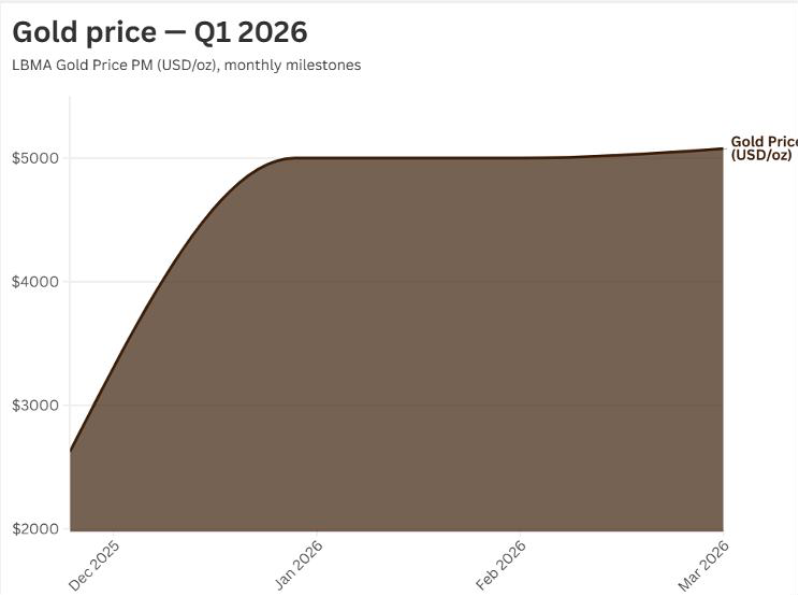
Gold had an extraordinary quarter globally, and African producers, particularly in South Africa, Ghana, Mali, Tanzania, and the DRC, were direct beneficiaries.
According to the World Gold Council, the LBMA Gold Price PM in USD delivered its strongest January since 1980, surging 14% in the month and closing at $4,982/oz, an all-time high. In February, the price rose another 4.8%, with gold briefly touching $5,000/oz before pulling back. By March, prices remained above the $5,000/oz threshold, supported by geopolitical tensions in the Middle East, safe-haven demand, and a weaker US dollar.
For African gold-exporting nations, this matters enormously. South Africa’s JSE rally was partially driven by gold mining stocks. Ghana’s fiscal position benefits from higher gold revenues. The WGC noted that global gold demand hit an all-time high in 2025, and central banks around the world continued buying in Q1 2026, with the People’s Bank of China
adding gold for its 15th and 16th consecutive months.
Capital flows: Portfolio money in, FDI still struggling
Nigeria’s capital inflow data illustrates a continent-wide pattern. The country received $6.44 billion in foreign capital inflows in Q4 2025, a 26.6% year-on-year increase. But 85% of that was portfolio investment; treasury bills, bonds, and equities, not long-term foreign direct investment. Nigeria’s FDI for all of 2025 was just $923 million, representing less than 4% of total capital importation.
This mirrors the broader African picture. UNCTAD data shows that Africa’s FDI fell by roughly one-third in 2025 to about $59 billion, even as global FDI rose 14%. Egypt remained Africa’s top FDI destination, with approximately $11 billion in FDI. Mozambique saw an 80% surge in inflows as major LNG projects resumed. Angola returned to positive FDI territory after nine consecutive years of net divestments.
The implication is that Africa is attracting financial capital, but not yet the long-term productive capital that builds infrastructure, creates jobs, and drives durable growth. The deals that do exist are increasingly structured and DFI backed.
Notable deals this quarter
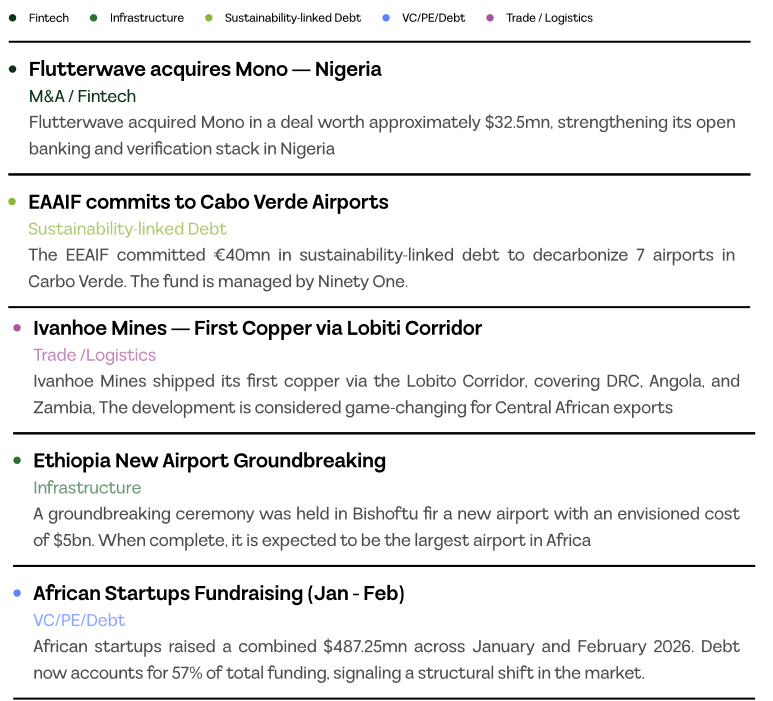
Several transactions defined Q1 2026’s investment landscape: