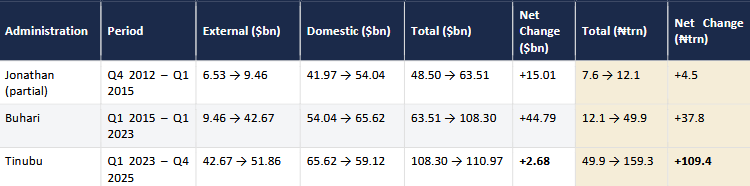
Most of the criticism around Tinubu’s borrowing record has centred on external debt, but the domestic figures add important context. In dollar terms, domestic debt eased from about $65.6 billion in Q1 2023 (Buhari era) to $59.1 billion by end- 2025 (Tinubu era), a decline of roughly $6.5 billion. That sits against an increase of around $11.6 billion during the Buhari years. When you put domestic and external debt together, total public debt rose by only about $2.7 billion in dollar terms between Q1 2023 and Q4 2025, even though the naira headline rose by roughly ₦109.4 trillion over the same period. Both figures are correct, but only the dollar measure reflects actual new borrowing.
Between Q1 and Q2 2023, the naira value of external debt rose from ₦19.6 trillion (Buhari) to ₦33.2 trillion (Tinubu) with little change in dollar terms, reflecting exchange rate unification and revaluation of existing debt. In the same period, domestic debt increased from ₦30.2 trillion (Buhari) to ₦54.1 trillion (Tinubu), driven primarily by the securitisation and balance sheet recognition of ₦23.9 trillion in Ways and Means advances; previous Central Bank overdrafts accumulated under Buhari and subsequently converted into marketable government debt instruments. These movements represent accounting reclassification and stock revaluation adjustments, not incremental fiscal borrowing flows.
Excluding the Ways and Means securitization, about ₦30.7 trillion in net new domestic issuance has been recorded since mid-2023. However, the dollar decline in domestic debt reflects exchange rate depreciation and valuation effects, which mechanically reduce the foreign-currency equivalent of naira-denominated liabilities. Overall, exchange-rate pass-through effects account for most of the volatility in debt figures, while the underlying increase in net new borrowing is materially smaller than the naira aggregates suggest.
Figure 3: Nigeria’s Public Debt by Administration: Entry, Exit, and Net Change