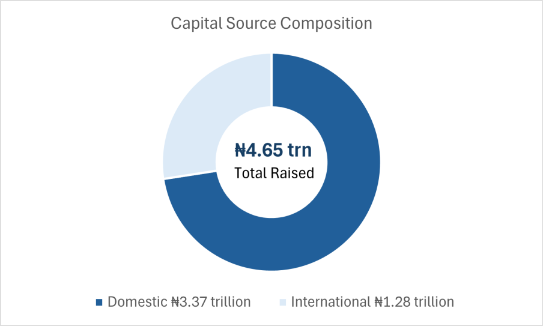
Domestic investors accounted for ₦3.37 trillion, representing 72.55% of total capital raised, while international investors contributed ₦1.28 trillion.
This composition reflects a structural shift within Nigeria’s financial system. Unlike earlier reform cycles that depended heavily on public sector support, the 2024–2026 exercise relied primarily on private savings mobilisation.
However, Nigeria’s investment requirements remain significantly larger than current capital mobilisation levels.
The challenge therefore is increasingly not whether capital can be mobilised, but whether larger pools of long- term capital can be developed and allocated efficiently.