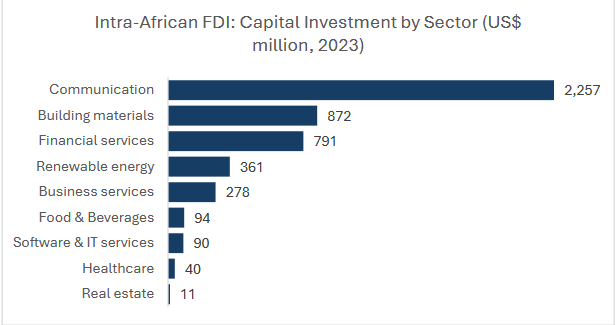
African investors accounted for 14% of all investment projects on the continent in 2023, but less than 3% of total capital deployed and about 5% of jobs created (EYAfrica)This imbalance highlights a clear structural issue: African firms are increasingly investing across borders, but with limited financial capacity.
The sectoral difference is equally important. Unlike external FDI, which remains heavily concentrated in extractive industries, intra-African greenfield investments are increasingly directed toward financial services, manufacturing, logistics, telecommunications, and digital infrastructure. In simple terms, external capital extracts value, while African capital builds systems.
The scale of the financing gap is significant. The AfDB estimates Africa requires between $130 billion and $170 billion annually to address its infrastructure deficit alone. Against this benchmark, total intra-African FDI stock of $76 billion highlights the scale of the capital mobilisation still required. This mismatch shows that Africa’s key constraint is not investment activity, but insufficient capital depth. Closing this gap remains one of the continent’s most important financial challenges over the next decade.
Within this landscape, South African firms are the largest source of intra-African investment by scale, followed by Morocco and Egypt. Nigeria and Kenya are also emerging as increasingly important regional investors, particularly in banking, fintech, and telecommunications.