Nigeria’s main fiscal constraint is not the size of its debt, but the weakness of revenue generation relative to spending needs. The macroeconomic outlook remains broadly positive, with both the IMF and World Bank projecting GDP growth of 4.4% in 2026, alongside a slight upward revision of 0.2 percentage points from earlier forecasts. This signal continued, if moderate, economic expansion.
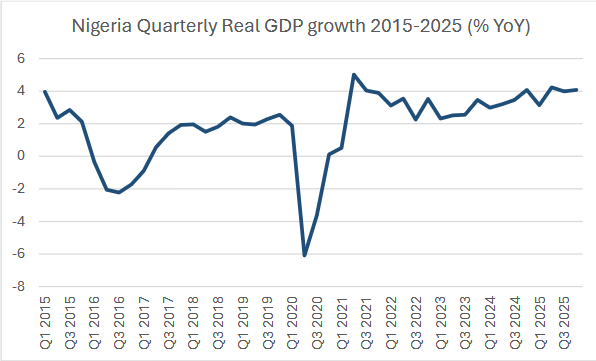
Figure 2 presents quarterly real GDP growth from Q1 2015 to Q1 2026. However, stronger growth is not
translating into stronger fiscal capacity.
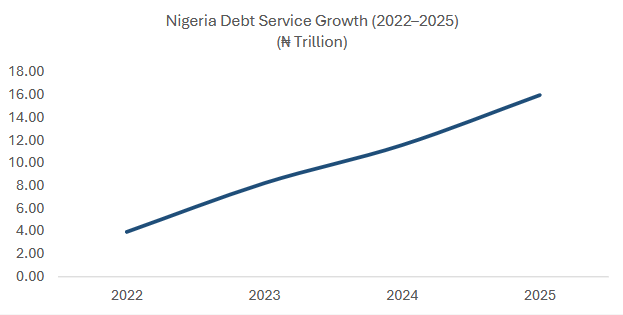
In the 2026 budget, debt service is projected at ₦15.8 trillion, higher than the ₦15.4 trillion allocated to running government operations, and larger than combined spending on key sectors such as education, health, and security.
Debt service has also risen sharply over time, increasing from below ₦4 trillion in 2022 to almost ₦16 trillion in 2026. It now absorbs an estimated 50% to 60% of federally retained revenue, leaving limited room for other public spending.
The underlying issue is revenue underperformance, especially from oil. Between January and July 2025, the government generated ₦13.67 trillion against a target of ₦23.85 trillion, a shortfall of ₦10.19 trillion or 42.7%.
Oil revenue was the main driver of this gap, coming in at ₦4.64 trillion compared to a target of ₦12.25 trillion. In effect, when oil revenue falls so far below expectations, the government is forced to rely more on borrowing, which in turn adds further pressure on future budgets.