Nigeria’s Fiscal Paradox

Executive Summary

Nigeria heads into 2026 with a widening gap between strong economic growth and rising fiscal pressure.The economy is projected to grow by 4.4%, with GDP expected to reach $334 billion, supported by improving oil output and stabilising macroeconomic conditions. However, this growth is occurring alongside increasing strain on public finances.

Public debt rose to ₦159.27 trillion by the end of 2025, more than three times its 2023 level. Debt service obligations have also surged, reaching ₦15.8 trillion in the 2026 budget, and now absorb a significant share of federal revenue, reducing fiscal space for infrastructure, health, and education.

The central constraint is increasingly revenue, not borrowing capacity. Persistent shortfalls in oil earnings have widened fiscal gaps, meaning that despite steady economic growth, government finances remain under pressure. As a result, debt servicing now consumes around half of federal revenue, limiting the government’s ability to fund productive spending.

This pressure is reinforced by the structure of the debt itself. Domestic debt accounts for 53.27% of total obligations and is largely composed of short-term, higher-cost instruments, increasing refinancing and rollover risks. External debt remains more concessional in nature but is smaller in overall share.

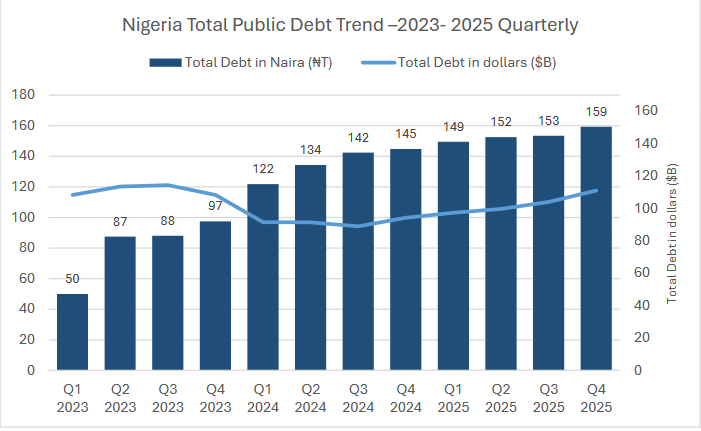
Figure 1 illustrates the quarterly trajectory of Nigeria’s public debt stock from Q1 2023 to Q4 2025,presented in both naira and US dollar terms. In naira, debt more than tripled from ₦49.85 trillion to ₦159.28 trillion. In dollar terms, however, debt fell from $108 billion in early 2023 to a low of $89 billion by mid-2024, before recovering to $111 billion by end-2025. The divergence reflects the naira devaluation of June 2023, which mechanically inflated the naira value of external obligations without representing new borrowing.
Download Brief

Growing Fast, Borrowing Faster: A Plain Look at Debt, Revenue, and the Tax Reform Test

Key Takeaway
Nigeria's debt has tripled in three years, and more than half of it now sits in expensive, short-term local loans. This forces the government to keep borrowing just to refinance old debt. The debt-to-GDP ratio of 32.3% looks fine on paper, but it hides how much pressure the loan calendar is putting on the budget every year.

Figure 1 illustrates the quarterly trajectory of Nigeria’s public debt stock from Q1 2023 to Q4 2025,presented in both naira and US dollar terms. In naira, debt more than tripled from ₦49.85 trillion to ₦159.28 trillion. In dollar terms, however, debt fell from $108 billion in early 2023 to a low of $89 billion by mid-2024, before recovering to $111 billion by end-2025. The divergence reflects the naira devaluation of June 2023, which mechanically inflated the naira value of external obligations without representing new borrowing.


In response, the Nigeria Tax Act 2025 aims to strengthen non-oil revenue, simplify the tax system, and improve collection efficiency. However, the reform is still in its early stages, and uncertainty around implementation and revenue targets remains a key risk.

For investors, the picture is mixed: economic growth continues to support private-sector opportunities, while fiscal constraints are increasingly weighing on public spending–dependent sectors.

This brief explains how both growth and fiscal pressure can exist at the same time, what problem the new
tax law is designed to solve, and what this means for investors in Nigeria.
The Real Problem Is Revenue,Not Debt

Key Takeaway
Nigeria's fiscal stress is really a revenue problem. The government is still able to pay its debts, but doing so leaves very little for roads, schools, hospitals, and other productive spending. For investors, this means government-dependent sectors will keep facing tight budgets until tax collection improves.

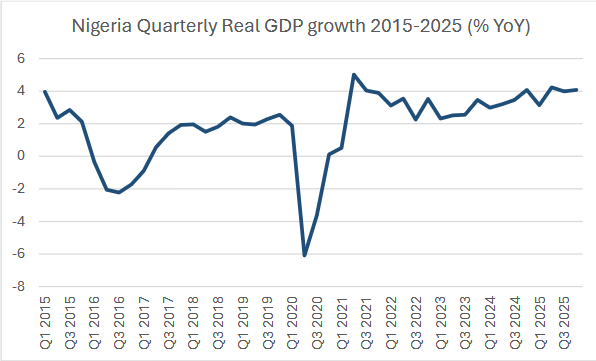
Nigeria’s main fiscal constraint is not the size of its debt, but the weakness of revenue generation relative to spending needs. The macroeconomic outlook remains broadly positive, with both the IMF and World Bank projecting GDP growth of 4.4% in 2026, alongside a slight upward revision of 0.2 percentage points from earlier forecasts. This signal continued, if moderate, economic expansion.


Figure 2 presents quarterly real GDP growth from Q1 2015 to Q1 2026. However, stronger growth is not
translating into stronger fiscal capacity.

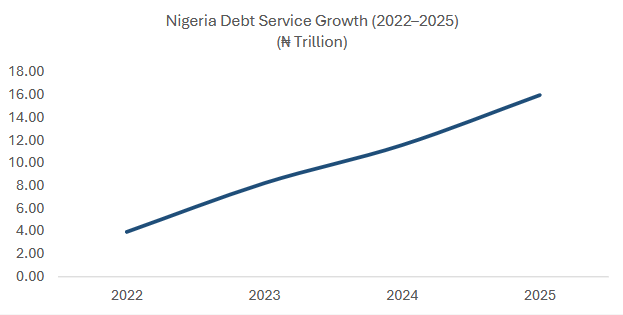
In the 2026 budget, debt service is projected at ₦15.8 trillion, higher than the ₦15.4 trillion allocated to running government operations, and larger than combined spending on key sectors such as education, health, and security.

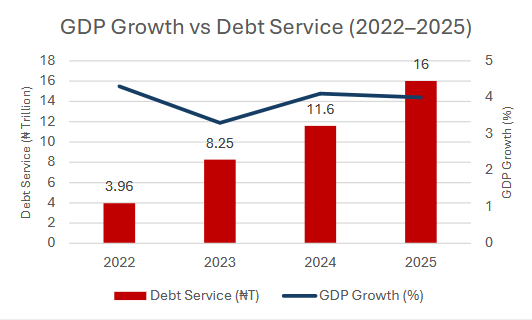
Debt service has also risen sharply over time, increasing from below ₦4 trillion in 2022 to almost ₦16 trillion in 2026. It now absorbs an estimated 50% to 60% of federally retained revenue, leaving limited room for other public spending.


The underlying issue is revenue underperformance, especially from oil. Between January and July 2025, the government generated ₦13.67 trillion against a target of ₦23.85 trillion, a shortfall of ₦10.19 trillion or 42.7%.

Oil revenue was the main driver of this gap, coming in at ₦4.64 trillion compared to a target of ₦12.25 trillion. In effect, when oil revenue falls so far below expectations, the government is forced to rely more on borrowing, which in turn adds further pressure on future budgets.

The Tax Reform: Nigeria’s Big Bet

Key Takeaway
The Nigeria Tax Act 2025 is the most important fiscal reform in a generation. If it works, it can rebalance the budget in three to five years. But it has not yet proved itself. The ₦40.7 trillion target is ambitious, the official numbers do not match independent figures, and the political response is still being tested. Treat tax reform gains as a medium-term possibility, not a 2026 certainty.

To close the widening revenue gap, the Tinubu administration introduced the Nigeria Tax Act 2025, which took effect on January 1, 2026 — the country’s first major tax overhaul in over 35 years.

The law simplifies taxation by merging over 60 taxes and levies into one system, exempts small businesses with turnover below ₦50 million from company income tax, and digitises collection for VAT, company tax, and withholding tax. The government targets ₦40.7 trillion in total tax revenue for 2026, with non-oil revenue expected to rise 37.9% to ₦24.836 trillion.

These measures aim to significantly improve Nigeria’s low tax-to-GDP ratio through better enforcement and digital tools. However, credibility concerns persist due to large gaps between official and independent debt-service-to-revenue figures. Political risks also remain high, as public resistance to major economic reforms could delay or weaken the expected gains.

Two Stories At Once: Growth And Constraint

Key Takeaway
Nigeria is at the same time one of Africa's best growth stories and one of its most fiscally squeezed governments. The upside is genuine: 4.4% growth, rising oil output, a deeper tax base, and a $334 billion economy. The downside is also genuine: debt service is crowding out productive spending, and the fiscal deficit has broken the legal ceiling. Investors should take exposure to the growth, but stay cautious on government-dependent assets.

Nigeria in 2026 is shaped by two realities moving in opposite directions.

On the one hand, the growth outlook remains positive. The IMF projects GDP to reach $334 billion in 2026, which could place Nigeria as Africa’s third-largest economy, behind South Africa and Egypt and ahead of Algeria. This is supported by rising oil production, improved foreign exchange liquidity, and gradual gains from earlier economic reforms.

On the other hand, fiscal conditions remain under pressure. Debt service is projected to absorb about 50% of federal revenue in 2026. At the same time, the fiscal deficit is expected to widen to ₦23.85 trillion, or 4.28% of GDP, above the 3% limit set under the Fiscal Responsibility Act.

The key risk is not sovereign default. Nigeria retains sufficient capacity to meet its debt obligations. The concern is instead a drag on growth, as an increasing share of public revenue is diverted toward interest payments rather than productive investment in infrastructure, power, and education. Over time, this limits the economy’s ability to fully translate growth into broad-based development, as debt servicing crowds out capital expenditure.

This pressure is being reinforced by continued borrowing. The House of Representatives has approved a $6 billion external borrowing request, expanding access to additional financing from lenders in the UAE and the UK. This further adds to a debt stock that has already more than tripled in the past three years.
As Figure 1 shows, this trajectory is visible across every quarter since 2023 — with naira-denominated debt rising steeply while the dollar series tells a more nuanced story shaped largely by exchange rate adjustment rather than net new borrowing alone.


What This Means For Investors

For investors assessing Nigeria in 2026, three practical considerations stand out. First, the overall macroeconomic environment still supports private-sector exposure. Sectors that generate their own demand and are less dependent on government spending—such as banking, consumer goods, telecommunications, and parts of the energy sector—are positioned to benefit from projected GDP
growth of 4.4%.

Second, caution is warranted in sectors that depend heavily on fiscal spending. Infrastructure contractors, public-sector suppliers, and projects funded directly through the federal budget are likely to face tighter conditions, as rising debt service obligations continue to crowd out discretionary government expenditure.

Third, the trajectory of the tax reform will be a key variable to monitor. If non-oil revenue continues to improve toward the ₦24.836 trillion target, it would gradually ease fiscal pressure over the medium term. If revenue underperforms, it would likely result in continued reliance on borrowing, increased pressure on the naira, and tighter overall financial conditions.


Closing Note 
Nigeria’s situation in 2026 is not a traditional debt crisis. The country remains able to meet its debt obligations. The real challenge is a revenue shortfall: the economy is growing, but government revenue is not growing fast enough to match spending needs.

The Nigeria Tax Act 2025 is the government’s main response to this problem. It aims to strengthen non- oil revenue and improve tax collection efficiency. Countries such as India and Egypt have pursued similar reforms and achieved stronger fiscal positions over a five- to seven-year period. Nigeria now has the policy framework in place, but it has not yet built a performance track record.

The next 12 to 18 months will be critical in assessing whether revenue growth can meaningfully ease debt service pressures before they lead to tighter spending conditions. For now, the direction of reform is broadly positive, but the speed of implementation will determine the outcome.

Partnership Brochure Download Form