Environmental sustainability and climate adaptation
Environmental, Social, and Governance dynamics are increasingly shaping Africa’s development trajectory, investment landscape, and long-term economic resilience. Environmental pressures from climate change, biodiversity loss, and pollution are intensifying, threatening livelihoods and economies heavily reliant on natural resources and agriculture. On the social front, ESG is promoting greater attention to financial inclusion, labour standards, community welfare, and social infrastructure. The growth of social and sustainability-linked ties across the continent is helping channel capital toward other sectors. In terms of governance, African countries and financial institutions are beginning to adopt more robust ESG disclosure standards and corporate-governance practices driven by pressure from global investors, development banks, and regulatory reforms. Overall, ESG is emerging as a transformative framework for Africa, influencing capital flows, guiding sustainable development, and shaping how governments and businesses manage risk. The continent is moving gradually toward greater transparency, climate-resilience, and social impact, though the pace varies across regions.
Climate vulnerability/adaptation readiness indices
There is rising recognition among African policymakers, financiers, and international development institutions that ESG (and particularly environmental risks) must be integrated into finance and development planning. In 2024, Africa Development Bank (AfDB) organized the inaugural Africa ESG Forum to promote continent-wide ESG disclosure and adoption of sustainable practices. Africa is increasingly engaging with natural-capital accounting and ecosystem services frameworks, under initiatives such as the Global Program on Sustainability (GPS) of the World Bank, signalling a shift from viewing the environment solely as a cost/constraint to integrating environmental assets into economic planning. This means the rise of ESG-aligned financing (bonds, green/social investment) signals that environmental considerations are becoming part of the mainstream financing and investment budgets. This helps channel capital toward climate-resilient, sustainable projects (renewables, conservation, infrastructure, social housing, etc.) rather than only resource-extraction or high-impact industries.
There has been a -16% reduction in return on assets in Nigeria, Ethiopia -75% from 2015 to 2021, while there have been 10% and 40% increment in Ghana and Tanzania, respectively, during the same duration. These suggest many African banks remain fairly profitable despite macroeconomic headwinds. High return on assets, especially in countries like Ghana and Tanzania, indicates good conditions for investors, which can attract more capital and support bank expansion.
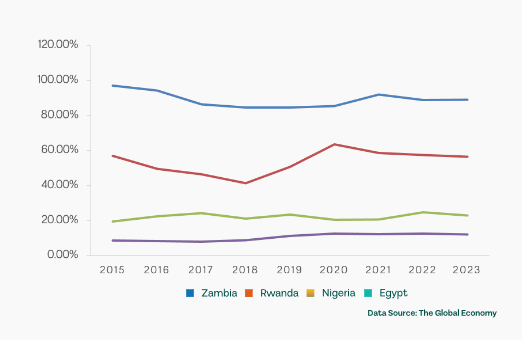
East and North Africa currently attract the most diversified FDI. Egypt in North Africa has a total sum of $118 billion from 2015 to 2024. It is important to note that each country in Africa had a downturn in 2020 due to the pandemic. While Egypt has the highest sum and Kenya has the lowest, the common drivers of foreign direct investments in these Countries like Zambia are above the global average in renewable energy production and consumption, above 85% in total consumption is coming from clean energy. Rwanda, Nigeria, and Egypt have lower levels and a decline from 2015 to 2023. The major source of renewable energy in Zambia, Rwanda, and Nigeria is hydropower. Solar energy is also emerging in these countries. Egypt’s major source of renewable energy is solar energy. There’s a need for heavy investment in clean energy to promote climate awareness across the entire continent.
Finance and Health indicators (Capital formation and life expectancy)
ESG awareness among African financial institutions is rising. Many banks are beginning to adopt social-and-
environmental (E&S) principles, hire ESG staff, and attempt to integrate social risk management into credit, lending, and project-finance policies, especially in institutions based in South Africa and Kenya. They create funding for projects with explicit social goals: community development, social infrastructure, inclusive finance, climate-resilient livelihoods, etc. Research confirms that governance quality (i.e., good governance) is strongly correlated with better social, environmental, and economic development outcomes.
Health and education investment was once donor-led and limited in scale. Since COVID-19, health is seen as a security and economic priority, with growth in pharmaceuticals, diagnostics, health-tech, and local manufacturing. Education investment is shifting toward ed-tech, skills development, and vocational training aligned with labour markets. With limited public funding, blended finance and public-private partnerships are increasingly used. Both sectors are now recognized as core investments in productivity and long-term growth.
There has been a -16% reduction in return on assets in Nigeria, Ethiopia -75% from 2015 to 2021, while there have been 10% and 40% increment in Ghana and Tanzania, respectively, during the same duration. These suggest many African banks remain fairly profitable despite macroeconomic headwinds. High return on assets, especially in countries like Ghana and Tanzania, indicates good conditions for investors, which can attract more capital and support bank expansion.
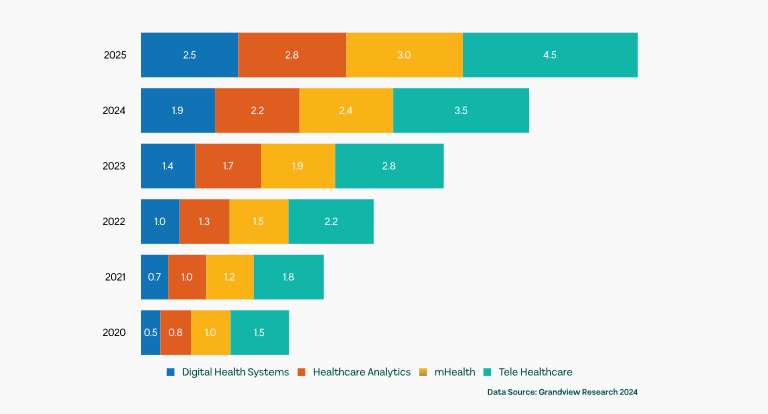
For example, coal is mostly the primary source of cooking in most countries in Africa. And coal is known to have health risks, such as lung diseases and indoor/outdoor air pollution. Using the recent investments in cooking gas by Africa’s richest man, Aliko Dangote, backed by the government, to fully eradicate the use of coal for cooking, to a cleaner and safer technique, to improve the life expectancy of the citizens. A case in point is the liquefied petroleum gas in Nigeria.
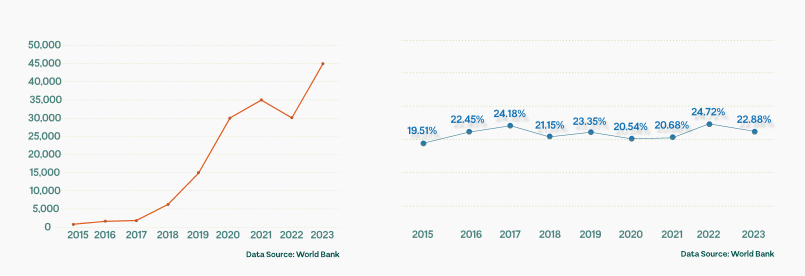
Figure 4.4: LPG Consumption in Nigeria
Nigeria has a 17% increment in the percentage of the population using cooking gas from 2015 to 2023. And has almost X50 consumption level from 2015 to 2023 (962 to 44,802). The data indicates Nigerians are slowly embracing a cleaner way of cooking. The strategic investments by Aliko Dangote, with the assistance of the government via clean energy policies and reforms, will help improve the standard of living and also increase the life expectancy rate among its citizens in the long run.
Governance, leadership, and institutional effectiveness
Institutional focus on ESG governance is rising. The 2024 ESG Forum by the African Development Bank aimed to promote ESG disclosure across Africa, recognizing governance and transparency as critical for sustainable development and investment flows. Better ESG governance and disclosure frameworks can attract international investors, especially as global capital increasingly seeks ESG-compliant assets. For African firms and banks, this could open access to more capital, lower borrowing costs, and improved credibility. In zones or countries with weak governance adoption, there is a risk of being sidelined from the growing sustainable-finance flows or facing a higher cost of capital due to ESG-related risk premiums.
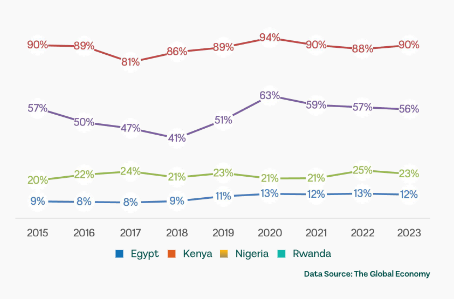
Governments in various countries are taking low-interest loans to increase renewable energy output. An example can be seen in Figure 31, where Egypt, Kenya, Nigeria, and Rwanda have seen fluctuation in renewable energy output, but we can’t deny the upward movement renewable energy had in these countries, which is a good sign. Governments across various countries in Africa are pushing policies to support green energy. Therefore, increasing the adoption of clean energy across various sectors in Africa. Kenya, for example, has massively adopted policies that promote clean energy, and it uses it to run the majority of the country, reducing pollution and heat emission from other sources of energy.
Are African governments fast enough to support growth?
Africa is at the beginning of a potentially transformational shift; ESG, once marginal, is becoming central to how finance, investment, policy, and development are framed on the continent. The combination of rising ESG-finance flows (sustainability bonds, green finance), growing institutional commitment (via AfDB, banks, regulators), and increasing global capital demand for ESG-compliant investments suggests substantial upside for sustainable development, environmental protection, and social inclusion. This means a shift toward truly sustainable, inclusive, resilient economies centres on building governance capacity, data and disclosure disclosure infrastructure, institutional transparency, and standardization of ESG frameworks. Without these, ESG finance risks are symbolic rather than substantive.
Regions with stronger institutional foundations (Southern Africa, parts of East and North Africa) are better positioned to lead the transition, but the greatest long-term risks lie in zones with environmental vulnerability, weak governance, and large rural populations (West & Central Africa’s fragile states). If ESG is not mainstreamed there, inequalities may widen, and vulnerabilities (climate, social, economic) may deepen.