Digital transformation and economic growth
Africa’s fintech and digital-technology ecosystem is entering a major era characterized by rapid mobile-money expansion, rising digital payments, emerging digital-credit models, and major advances in digital infrastructure. Yet progress is uneven, with regional strengths and systemic weaknesses shaping outcomes zone by zone. The more adults with financial accounts, the higher the level of financial transactions and volume, which in turn increases the level of total economic output.
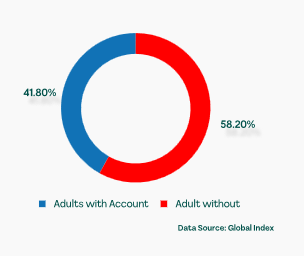
According to the 2025 Global Findex update, about 58.2% of adults (15+) in Sub-Sahara Africa had a financial account (bank or mobile-money/digitally enabled) in 2024, up from 49.3% in 2021.
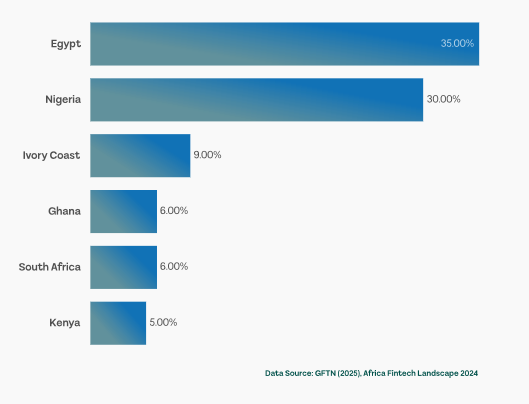
Fintech in Africa has moved beyond experimentation. The number of firms grew from about 570 in 2020 to over 1,000 by 2024, signalling a mature sector. In 2024, Kenya raised $638 million in fintech funding, while Nigeria raised about $400 million, showing clear regional hubs according to Partech 2024.
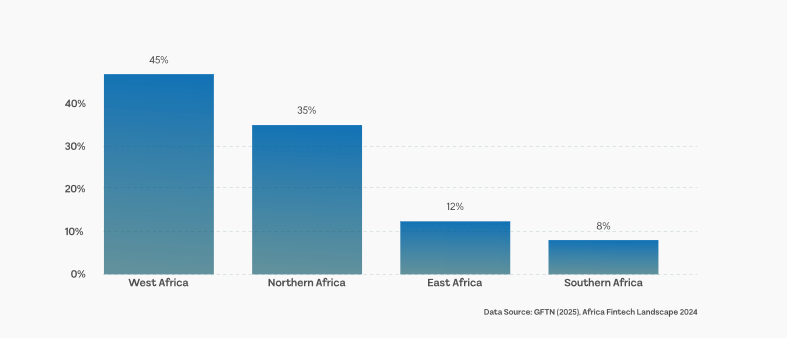
Historically, East and West Africa have been the pioneers of mobile-money-led inclusion (with countries like Kenya, Tanzania, Uganda) (see figure 34). The early arrival of mobile-money infrastructure there laid the foundation for high financial-account penetration through digital channels, especially in countries with supportive regulatory reforms.
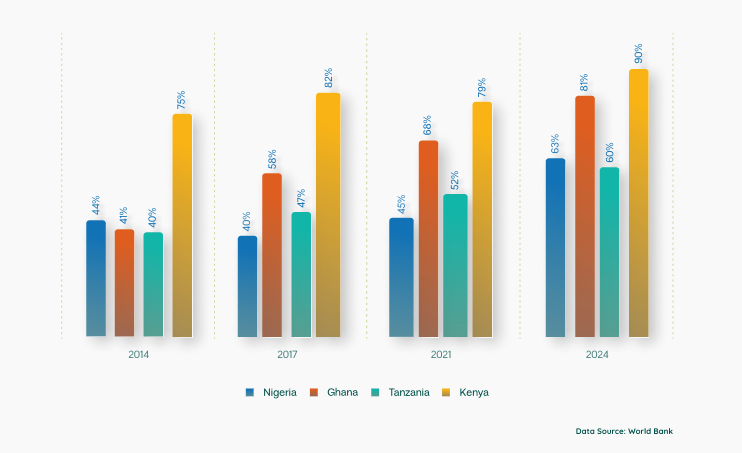
All of these countries (Nigeria, Ghana, Tanzania, and Kenya) have had an increase in account ownership, which indicates signs of improvements in financial inclusion (see Figure 35). Other zones (Central, Southern, and North Africa) have shown moderate account penetration; in many economies, traditional banks co-exist with growing digital financial services, indicating a hybrid model (bank + fintech). This means mobile-money and digital accounts are no longer marginal; they are central to expanding formal financial inclusion in Africa. Financial inclusion is expanding fastest where mobile-money infrastructure was early or where regulatory/market conditions allowed fintech/mobile-money growth. Thus, East and many West African economies are leading.
Digital Payments & Mobile-Money Usage
Digital transactions in emerging and developing economies (including SSA) surged sharply. According to the latest IMF Financial Access Survey, digital transactions per adult increased from 55 per adult in 2017 to 251 per adult in 2024. Mobile-money is now not just for remittances or P2P transfers but also for savings, bill payments, merchant payments, and small business transactions. The shift to digital payments is contributing to the broader formalization of financial flows, even among previously informal or cash-reliant segments.
In East and West Africa, mobile-money system users increasingly rely on digital payments for everyday transactions (P2P, merchant payments, bill payments, small business transactions). The high mobile penetration supports frequent digital usage. The other zone is also making headway in digital payments through traditional banking, but the low level of reliance on mobile money puts them behind East and West. In Central, Southern, and North Africa, banks remain dominant for higher-value transactions; however, wallets and e-money are gaining traction for smaller payments, remittances, and informal sector transactions. Digital payments, especially via mobile money, are transforming how Africans transact, offering more convenience, lower cost, greater inclusion, and financial transparency. The growth of digital payments lays the groundwork for more advanced financial services (credit, savings, micro-enterprise financing) because transaction history and digital footprints create traceable records, improve tax compliance, and enable better financial planning.
Fintech ecosystems and financial inclusion
While digital transactions have increased dramatically across developing economies, with emerging fintech credit services growing in parallel. Mobile-money accounts are not only used for savings and bill payments, but they are also used for lending: some countries report substantial proportions of formal borrowers using mobile-money providers rather than traditional banks due to their easy user interface and low entry barrier. Fintech growth is especially strong in the largest economies in Africa (e.g., Nigeria, Kenya, South Africa, Egypt). East and West Africa continue to lead in fintech-driven credit models as mobile-money credit (microlending) and savings-based credit have scaled substantially. Fintech-financed credit and savings are growing alongside traditional banking; forms like digital micro-finance, Neobanks, and digital savings platforms are gaining adoption in Central, Southern, and North Africa.
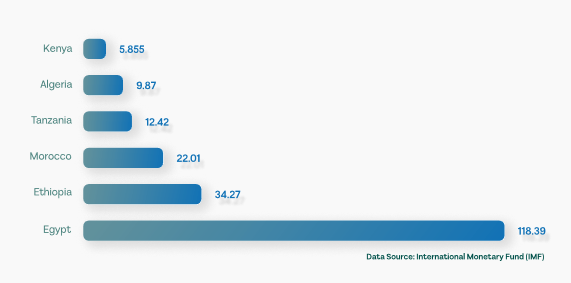
While Egypt has the highest FDI inflows and Kenya has the lowest, the common drivers of foreign direct investments in these countries are public infrastructure investments (often state-led), value chain investments, and clean power/energy investments. Stronger FDI inflows lower the cost of capital, create employment, and support technology transfer. Meanwhile, weak foreign direct investment, especially in Central Africa, reflects continued governance and regulatory risks. Fintech credit and digital finance are expanding the reach of credit and financial services,especially to underserved, unbanked populations, enabling small businesses, micro-entrepreneurs, and individuals to access credit, save, and transact. This can fuel economic activity, entrepreneurship, and investment at grassroots and SME levels, which traditional banking might not reach due to high costs or risk aversion.
Innovation, start-ups, and technology hubs
Mobile-phone ownership and smartphone penetration have expanded dramatically, underpinning the reach of fintech and digital finance. According to the 2025 Digital Connectivity Tracker, a large share of adults in low- and middle-income economies own mobile phones. The fintech ecosystem across Africa has matured: more fintech start-ups, growing investment in fintech, wider agent networks for mobile-money, and increasing digital-finance infrastructure deployment (wallets, payment rails, data centres) in key economies.
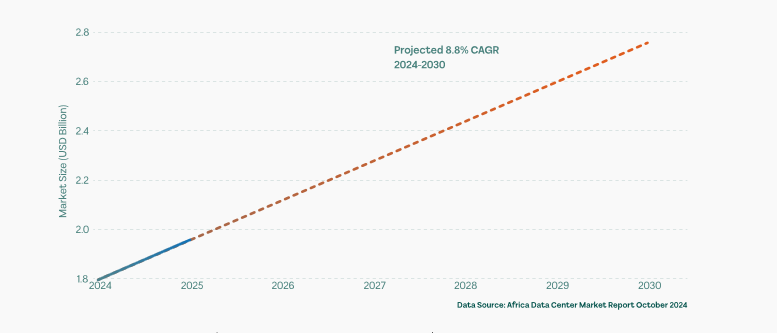
Rising infrastructure investments, growing fintech presence in countries like Nigeria, Ghana, Côte d’Ivoire; means the growth of fintech in Africa is built on data integration as mobile money is now be used as a mode of payment, credit facilitation, insurance, etc., As figure 37 shows increase in consumer data will also lead to increasing venture financing, fintech start-ups, and mobile-money operators. This is building a strong foundation for digital-finance infrastructure in West African countries. High mobile penetration, robust fintech ecosystems (P2P payments, digital credit, micro-insurance, agent networks), and growing innovation capacity in the East. More stable internet and telecom infrastructure; digital literacy and regulatory standards are relatively advanced in the South, while Infrastructure remains a bottleneck — lower mobile/internet penetration, limited fintech provider presence, poor agent networks outside urban centres, as Innovation capacity remains low in Central and most North Africa countries. But there is growing interest in digital banking, e-payment systems, and fintech start-ups, particularly in urban areas. Digital infrastructure (mobile networks, internet, smartphone penetration) is the backbone for fintech adoption. Regions with strong infrastructure stand to gain the most from fintech-led financial inclusion and digital finance. Where infrastructure lags, growth of fintech and financial inclusion may be constrained, leading to persistent disparities. As fintech ecosystems mature, innovations beyond payments, such as digital credit, savings, micro-insurance, and data-driven financial services, become feasible, deepening financial intermediation.
Strategic frameworks and digital trust
From a strategic-development and investment perspective, the trends above suggest the following. Financing Ecosystem Deepening as digital account ownership and payments rise, pools of domestic savings are likely to grow. This creates raw material for investment, credit, and financial intermediation — potentially reducing reliance on foreign capital. Small and medium-sized enterprises’ growth & entrepreneurship in Fintech-based credit and digital payments lower entry barriers for small businesses and micro-entrepreneurs, particularly in underserved or rural areas. This could democratize entrepreneurship, support economic diversification, and promote regional financial integration with the expansion of mobile money and fintech across the zone.
With rising cross-border trade and remittances, there is an opportunity for pan-African payment rails and interoperable fintech infrastructure linking economies like MTN Momo, easing remittances, and fostering regional trade. Risk & regulatory challenges in rapid fintech growth must be matched with regulatory frameworks, consumer protection, data privacy, digital-literacy initiatives, and infrastructure investment. Otherwise, risks of exclusion, fraud, over-indebtedness, and inequality may rise.
Is technology translating into productivity and inclusion gains?
After more than a decade of mobile-money pioneering and incremental fintech growth, Africa is entering a phase of maturation and structural transformation in financial services. In zones with strong fintech ecosystems, financial inclusion is transitioning from basic account ownership to comprehensive digital financial services like payments, savings, credit, micro-finance, and digital banking. Digital payments and mobile-money adoption are becoming the norm for everyday transactions, savings, and remittances, especially among previously unbanked populations. Fintech is emerging as a viable alternative (or complement) to traditional banking, particularly in serving SMEs, informal sectors, rural populations, and younger demographics.