Africa Relative to Emerging and Frontier Markets
Africa occupies a unique spot in the global investment landscape, sitting between emerging and frontier markets. While it makes up just over 3 percent of the world’s GDP in nominal terms and nearly 7 percent in purchasing power parity, the continent is home to 18 percent of the global population and has the fastest-growing labor force in the world (IMF, 2025; UNDESA, 2024). This large and young population sets Africa apart from other frontier regions and underpins its long-term investment potential.
Compared with emerging Asia, Africa’s growth is more uneven and volatile, held back by infrastructure gaps and fiscal constraints. Still, it grows faster than advanced economies and Europe, and in some areas, it keeps pace with parts of Latin America in terms of reforms and resilient domestic demand. Unlike more mature emerging markets, African returns are less tied to global cycles, offering a valuable diversification benefit for global investors.
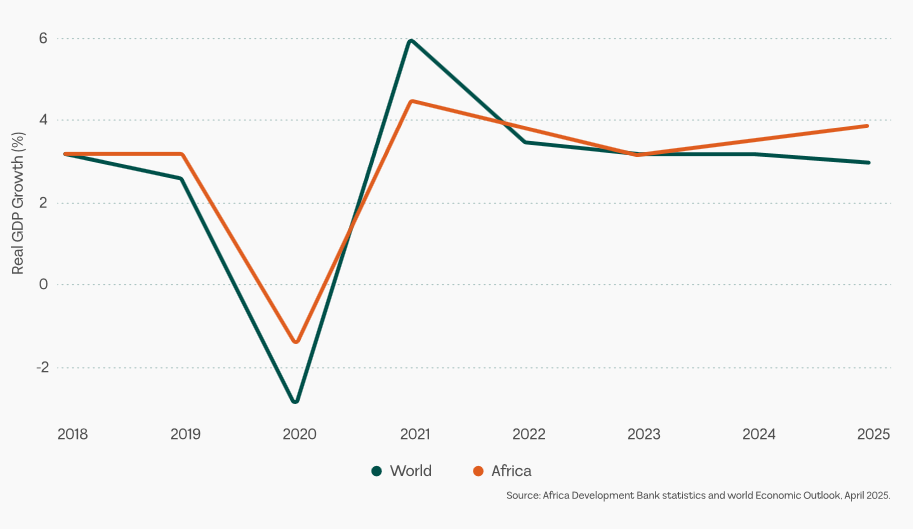
Real GDP: Africa vs World. 2018-2025
Global Macroeconomic Conditions and Their Influence on Returns
Global economic conditions in 2025 have been highly volatile. World growth slowed to 2.8 percent, reflecting tighter financial conditions, renewed trade restrictions, and weaker cross-border investment flows (IMF, 2025). Elevated U.S. interest rates increased borrowing costs for African sovereigns and corporates, contributing to portfolio rebalancing away from riskier assets and tightening liquidity conditions.
Slower Chinese growth reduced demand for African commodities, particularly metals and energy, affecting export revenues and fiscal balances in resource-dependent economies. At the same time, global commodity price volatility created asymmetric effects: higher agricultural and fertilizer prices raised inflation and production costs, while declining energy and metal prices compressed revenues for oil- and mining-dependent states (AfDB, 2025).
Despite these headwinds, Africa’s projected GDP growth of 3.9 percent in 2025 and 4.0 percent in 2026 places the continent above the global average, reflecting resilience driven by consumption, infrastructure investment, and reform momentum (AfDB, 2025; IMF, 2025).
Capital Flows, Investor Sentiment, and Market Liquidity
Capital flows into Africa have become more selective rather than uniformly risk-averse. While official development assistance and concessional financing have declined, private capital is increasingly targeting renewable energy, digital infrastructure, agribusiness, and regional value chains. Equity and bond investors are differentiating more sharply across countries, rewarding those with credible reforms, transparent policy frameworks, and improving debt sustainability.
Investor sentiment remains sensitive to global shocks, particularly U.S. monetary policy and geopolitical tensions. Episodes of risk-off behavior continue to affect liquidity in African capital markets, especially in smaller exchanges and corporate bond markets. Nevertheless, deeper domestic investor bases and growing pension fund participation are gradually improving market resilience and reducing reliance on volatile foreign flows.
Currency Dynamics, Inflation,and Interest Rates
Currency volatility remains one of the most important drivers of African investment returns. In 2025, countries that achieved greater exchange rate flexibility and reserve accumulation experienced improved investor confidence and lower risk premiums. Conversely, economies facing persistent foreign exchange shortages or delayed reforms saw currency depreciation erode USD-denominated returns.
Inflationary pressures, largely driven by food prices, currency pass-through, and supply-side constraints, remain above target in many countries. Central banks have responded with tight monetary policies, though signs of stabilization in inflation and growth have allowed selective easing in reform-oriented economies. Interest rate differentials continue to shape carry trade opportunities, but currency risk remains a decisive factor for international investors.
Africa’s Positioning for 2026
Africa’s role in the global investment landscape is evolving from commodity dependence toward greater diversification and regional integration. The rollout of the African Continental Free Trade Area (AfCFTA), combined with demographic growth, urbanization, and technological adoption, is strengthening intra-African trade and domestic value creation.
While global uncertainty, geopolitical risks, and financial tightening remain constraints, Africa’s medium-term outlook is underpinned by structural reforms, expanding consumer markets, and growing investment in green and digital infrastructure. As a result, Africa is increasingly positioned not merely as a high-risk frontier, but as a differentiated growth region offering selective, risk-adjusted opportunities for long-term investors.