FX as the Dominant Driver of Returns
In Africa, foreign exchange markets have evolved from a secondary macro factor to the primary driver of investment outcomes. Over the past decade, currency movements have increasingly determined USD-denominated returns across equities, fixed income, and alternatives, often outweighing underlying asset performance. Rising cross-country dispersion, persistent volatility, and pronounced downside risks mean FX is now an explicit allocation decision rather than a passive risk.
In 2025, African currencies proved more resilient than expected despite global volatility, supported by stronger domestic fundamentals.
FX Performance Against the USD and Global Peers
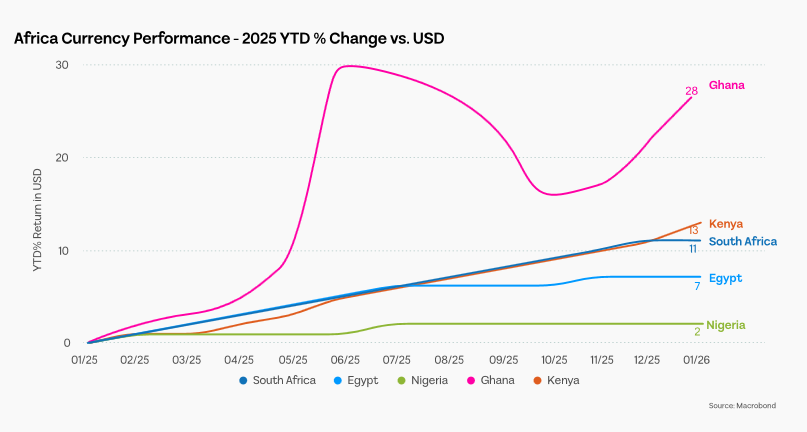
African currencies showed sharply divergent performance in 2025. Ghana, Uganda, and Zambia recorded strong appreciations of 28%, 24%, and 19%, reflecting successful currency stabilization and credible policy frameworks. In contrast, Tanzania and Ethiopia faced significant depreciation of 21% and 5%, driven by external financing pressures and reserve constraints. Nigeria and Egypt remained relatively stable, moving only 2% and 7%, while Kenya and South Africa posted moderate gains of 13% and 11%.
These differences are largely explained by policy credibility, reserve adequacy, and access to external financing, rather than underlying growth trends. The contrast between Ghana’s 28% gain and Tanzania’s 21% loss illustrates how policy frameworks and financing conditions have become the key determinants of FX outcomes. This reflects the structural fragility of African currency markets, where some economies achieve stability while others continue to face depreciation pressures, even within similar macroeconomic contexts.
Compared with emerging and frontier market peers, African currencies exhibit more frequent drawdowns, slower recoveries, and higher sensitivity to commodity and terms-of-trade shocks.
Volatility and Drawdowns: Evidence of a Regime Shift
African foreign exchange markets have shifted from episodic, event-driven volatility to a persistently elevated baseline. Structural factors such as thin liquidity, constrained policy space, and repeated external shocks have made heightened volatility the new norm for investors.
Currency drawdowns have become deeper and more prolonged, with slower recoveries. In 2025, Tanzania’s 21% decline unfolded steadily with little reversal, while Ghana’s early-year volatility took months to stabilize. This growing asymmetry between losses and gains increases the cost of unhedged positions and challenges short-term trading strategies. For portfolio managers, these dynamics signal a regime where traditional risk frameworks may no longer suffice.
Structural Drivers of African FX Performance
African currency movements are increasingly driven by structural factors rather than economic growth alone. Key drivers include FX market reforms, central bank credibility, tight foreign exchange supply, high debt servicing costs, and dependence on commodity exports. External factors, such as global interest rates and US Dollar strength, further influence currency performance, often overriding domestic growth trends. Together, these structural forces have transformed African currencies into instruments whose stability depends more on policy, reserves, and market architecture than on GDP growth.
Exchange rates that start overvalued are prone to sharp corrections, while countries that adjust gradually experience lower volatility. Adequate foreign reserves are now the key stabilizer, enabling faster recoveries from shocks. Liquidity constraints and capital controls add pricing premiums and tail risks. Stable currencies may offer lower nominal returns but preserve capital, whereas high-yield currencies carry persistent depreciation risk and rising hedging costs, limiting their net attractiveness for investors.
Implications for 2026
Looking ahead, FX will continue to dominate total returns across African asset classes. Dispersion across currency regimes is likely to remain high, with stability, reserve adequacy, and policy credibility outweighing nominal yield in determining investability. Elevated hedging costs will constrain foreign participation, reinforcing the importance of currency regime selection as a core portfolio decision.