Overview: Alternatives as Structural Return Drivers
Alternative investments have become an increasingly important pillar of African portfolios, offering access to long-term growth, structural transformation, and returns less correlated with public markets. Private equity, venture capital, infrastructure, real assets, and impact-oriented investments now play a central role in financing energy transition, digitalization, urbanization, and productivity gains across the continent. While these assets are inherently illiquid, their return profiles are shaped by long-duration cash flows, operational value creation, and exposure to secular growth themes rather than short-term macro volatility.
Private Equity and Venture Capital: From Experimentation to Scale
Africa’s private equity and venture capital ecosystem has expanded rapidly over the past five years, reflecting increasing market maturity. Venture deal volumes rose from approximately 140 transactions in 2019 to nearly 500 by 2024, alongside a steady increase in average deal sizes. This shift reflects a transition from early-stage experimentation toward growth-stage funding, supported by improved revenue visibility, stronger governance, and deeper global investor participation.
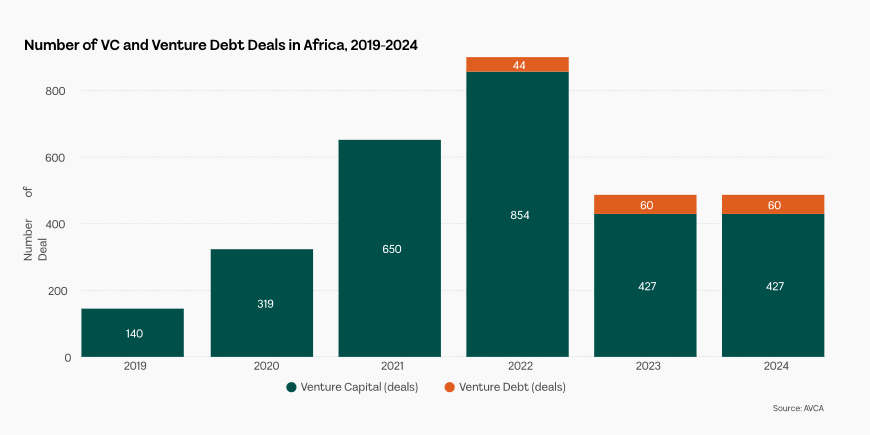
Deal activity in Africa has grown significantly over the last five years. According to AVCA, the number of venture capital deals rose from 140 in 2019 to an estimated 487 in 2024, reflecting a more mature and active ecosystem.
Deal activity remains concentrated in Nigeria, Kenya, Egypt, and South Africa, where digital infrastructure, talent pools, and investor networks are most developed. However, emerging hubs such as Senegal, Morocco, Rwanda, and Ghana are beginning to attract capital, indicating gradual geographic diversification.
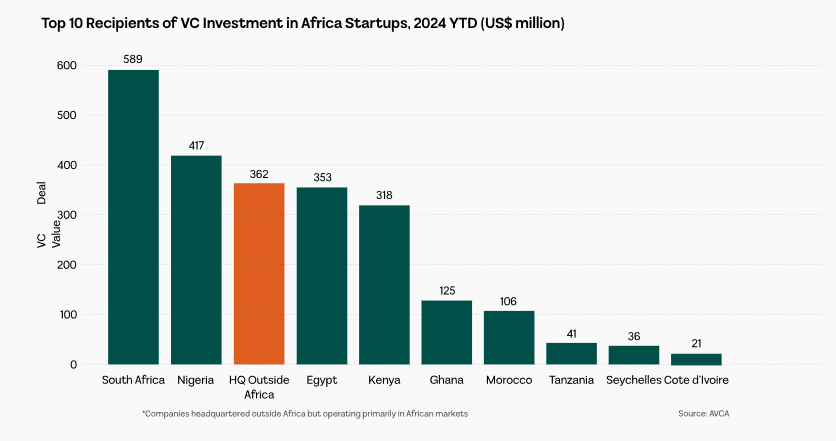
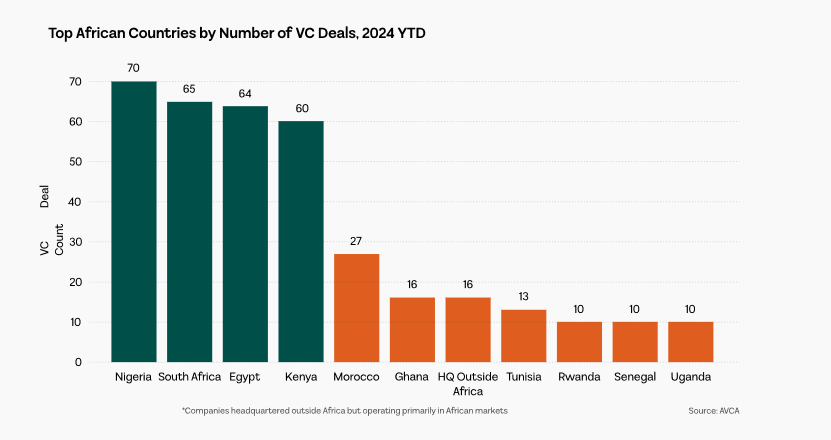
Africa’s venture landscape remains highly concentrated, with Nigeria, Kenya, Egypt, and South Africa accounting for the bulk of startup activity and capital inflows. Although these four markets were already dominant five years ago, their lead has strengthened due to deeper investor networks, maturing tech ecosystems, and a higher density of scalable ventures.
Investment stage composition has also evolved. Earlier cycles were dominated by seed and Series A rounds. Today, a growing share of capital is flowing into growth and late-stage deals. Venture debt, while still a small segment, is expanding as an alternative source of funding, helping scaling firms preserve equity while extending runway. Together, these trends point to a market that is increasingly able to support follow-on capital, structured financing, and institutional-scale exits.
Infrastructure and Real Assets: Long-Duration Cash Flows
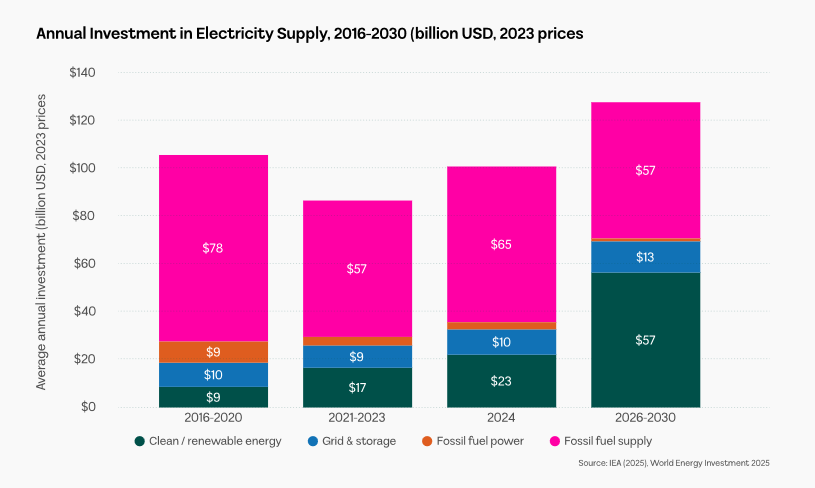
Infrastructure and real assets anchor Africa’s alternatives market, providing stable, inflation-linked cash flows tied to essential services. Over the past five years, investment has shifted decisively toward renewable energy, integrated transport systems, and digital infrastructure.
Renewables now dominate new project pipelines, driven by declining technology costs, climate finance flows, and strong development finance institution participation. Solar and wind, alongside mini-grid and off-grid systems, are expanding quickly as grid reliability remains uneven. Even so, the energy gap is wide. Africa still needs to add roughly 16 GW of grid capacity each year just to meet baseline demand growth.
Africa’s venture landscape remains highly concentrated, with Nigeria, Kenya, Egypt, and South Africa accounting for the bulk of startup activity and capital inflows. Although these four markets were already dominant five years ago, their lead has strengthened due to deeper investor networks, maturing tech ecosystems, and a higher density of scalable ventures.
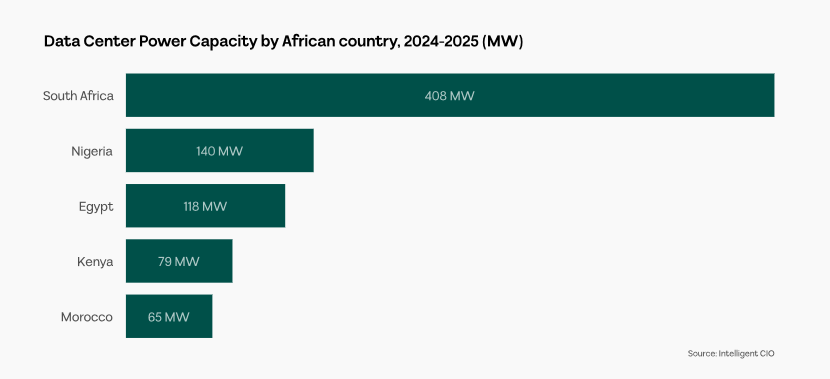
Digital infrastructure is also scaling quickly. Data center capacity is rising alongside fiber rollout and cloud adoption, though access remains uneven and power constraints continue to limit expansion in several markets.
ESG, Impact, and Sustainable Finance
Environmental, social, and governance considerations have transitioned from the margin to mainstream investment criteria within African alternative assets. Green bond issuance remains limited, with the continent representing only USD 5.1 billion of the global USD 2.2 trillion green bond market according to the Africa Policy Research Institute. However, sustainability-linked loans and ESG-focused private equity strategies have gained significant traction, particularly in energy, agriculture, and infrastructure sectors.
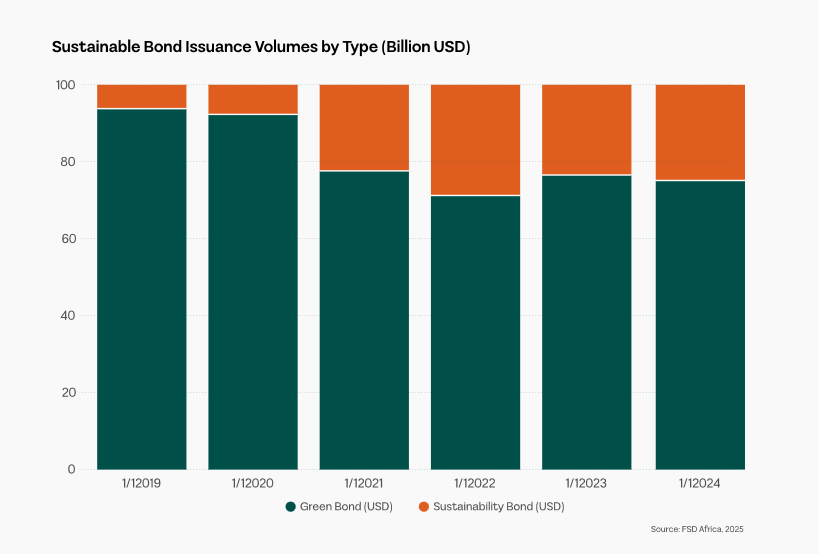
Sustainable finance is increasingly aligned with Africa’s development priorities, particularly renewable energy, climate-resilient infrastructure, inclusive finance, and digital access have emerged as primary investment themes. These efforts have cemented ESG as a structural feature of African investment markets, not a passing trend, strengthening accountability, improving measurement, and clarifying pathways for long-term capital deployment.
Regional Differentiation in Alternative Investments
Performance across Africa’s alternative investment landscape varies by region, shaped by differences in policy frameworks, infrastructure readiness, and capital absorption capacity. North and Southern Africa attract the largest shares of private infrastructure and real asset capital, supported by stronger institutions and deeper project pipelines. East Africa leads in growth-oriented alternatives, particularly renewable energy, digital infrastructure, and agribusiness. West Africa combines demographic scale with rising private participation, though infrastructure gaps persist. Central Africa remains underpenetrated despite its resource base, constrained by governance, financing, and project preparation challenges.
Risk-Adjusted Returns and Exit Dynamics
Alternative assets often outperform public markets on a gross basis, but risk-adjusted returns hinge on execution, governance, and exit timing. Exits are uneven, dominated by trade sales and secondary transactions, with IPOs limited. Longer holding periods highlight the need for patient capital. Compared with public markets, alternatives show lower mark-to-market volatility but higher idiosyncratic and liquidity risk, with returns driven increasingly by operational improvements, scale, and long-term demand rather than financial engineering.
Outlook for Alternatives
Africa’s alternatives landscape is entering a phase of consolidation and institutionalization. Private capital is expected to play a growing role in financing infrastructure, energy transition, digital connectivity, and scalable enterprises, particularly as public balance sheets remain constrained. Returns are likely to remain attractive for investors able to manage illiquidity, regulatory risk, and execution complexity.
The long-term investment case rests on structural demand, demographic growth, and improving institutional frameworks. However, success will increasingly depend on selectivity, regional differentiation, strong local partnerships, and disciplined capital deployment.