State of Africa’s banking and financial systems
Africa’s financial landscape is undergoing a structural evolution shaped by profitability ratios, external capital flows, financial stability indicators, and macro-price dynamics. The interplay of Return on Assets, Foreign Direct Investment, Non-Performing Loans, and inflation reveals an uneven but generally improving trajectory across the continent’s regions. These metrics collectively brighten how banks are adapting, how investors are allocating capital, and how countries are building resilience. Taking a look into Africa’s economy via Investment climate, regulation, and financial stability.
Return on Assets measures how efficiently a bank uses all of its assets to generate profit. From buildings, vehicles, to computers, etc., because they are used in carrying out daily operations that generate profit. Return on Assets across African banks has been slowly rising after COVID-19 disruptions, supported by digitalization, better cost controls, and recovery in credit demand. Return on equity measures the return of stakeholders’ shares in businesses, including banks. Return on equity across regions ranged from about 15% in North Africa to 32% in West Africa, according to the Africa Development Bank (AFDB) in 2023. It is important to acknowledge the regional deviation; East and West Africa are showing the strongest ROA improvements, helped by fintech-led cost efficiencies, especially mobile banking. North Africa remains stable but is moderated by high sovereign exposure. While Central Africa shows a weaker return on assets owing to concentrated banking sectors and higher operating costs.
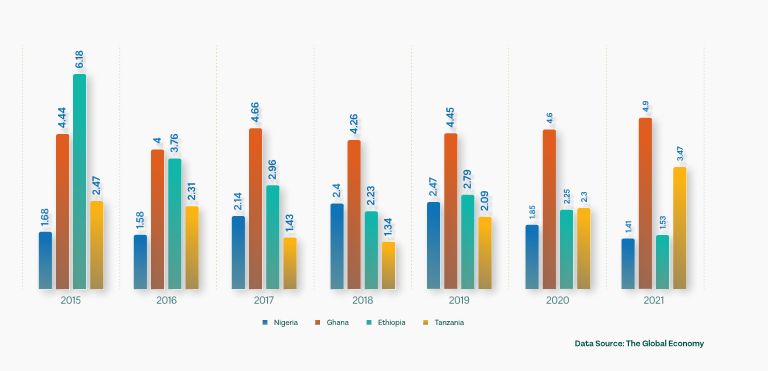
There has been a -16% reduction in return on assets in Nigeria, Ethiopia -75% from 2015 to 2021, while there
have been 10% and 40% increment in Ghana and Tanzania, respectively, during the same duration. These suggest many African banks remain fairly profitable despite macroeconomic headwinds. High return on assets, especially in countries like Ghana and Tanzania, indicates good conditions for investors, which can attract more capital and support bank expansion.
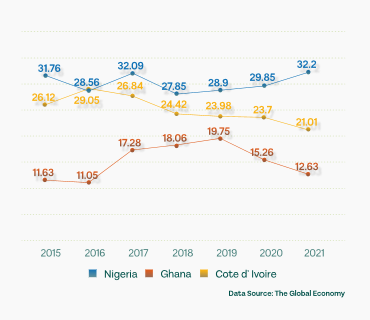
Investors in Nigeria, Ghana, and Côte d’Ivoire enjoy considerable returns on their investments in the long run due to profitable environments in the banking industry in the Western region. North Africa has steady but limited improvement due to heavy public-sector lending. West Africa, on the other hand, has return on assets generally trending upward as cross-border banking groups scale, thanks to the low operating costs of mobile banking and money. East Africa’s strong upward trajectory is supported by digital credit and telecom partnerships. Central Africa is slightly improving, as structural inefficiencies still limit growth. While Southern Africa is moderately improving, as banks rebalance away from interest income toward fee-based services. Banks are having more profitable portfolios, shifting toward small and medium enterprises with digital retail lending, restructuring capital Formation to boost bank profits, increase retained earnings, and support credit extension for infrastructure and private-sector projects.
Foreign Direct Investment shows the level of external confidence in the economy, which directly impacts capital inflows and long-term economic commitments. FDI flows are recovering but remain below pre-pandemic peaks. Investors are shifting focus from extractive industries toward manufacturing, renewables, logistics, and digital infrastructure.
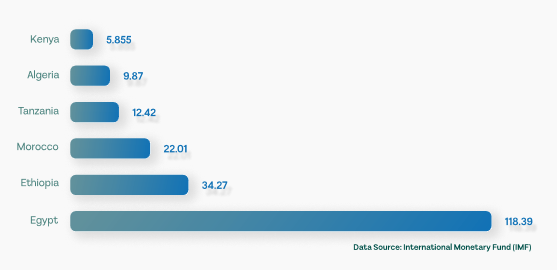
East and North Africa currently attract the most diversified FDI. Egypt in North Africa has a total sum of $118 billion from 2015 to 2024. It is important to note that each country in Africa had a downturn in 2020 due to the pandemic. While Egypt has the highest sum and Kenya has the lowest, the common drivers of foreign direct investments in these countries are public infrastructure investments (often state-led), value chain investments, and clean power/
energy investments. Stronger FDI inflows lower the cost of capital, create employment, and support technology transfer. Meanwhile, weak foreign direct investment, especially in Central Africa, reflects continued governance and regulatory risks.
Direction We Are Heading: North Africa is seeing rising foreign direct investment into energy transition projects (green hydrogen in Egypt, Morocco). East Africa’s stability increase is driven by tech, agribusiness, and regional trade integration. West Africa’s political transitions and currency pressures constrain inflows. In Central Africa, FDI inflows are weak and volatile, dominated by extractives. In Southern Africa, FDI is characterized by gradual recovery, with renewables as a source of inflows. Looking into the impacts by Sector, Banks prefer foreign direct investment increases because it improves demand for financial services, liquidity, and encourages competitive lending. For Investors, greater portfolio diversification and an increased craving for private equity. Capital Formation, foreign direct investment enhances domestic savings, accelerating industrialization, infrastructure growth, and boosts gross domestic product.
While Non-Performing Loans levels remain elevated in several countries but trend downward in regions adopting stronger credit analytics and regulatory reforms. In 2023, it ranges from 6% in Southern Africa to13% in Central Africa, according to the African Development Bank. The same report notes that banking sectors across the continent were characterized by “lower nonperforming loan ratios”, a positive signal. Post-pandemic legacy effects are still visible in tourism-dependent economies (North and East Africa).
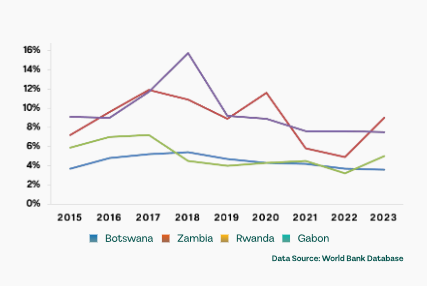
Since the post-pandemic period, Botswana has had a steady non-performing loans rate. Zambia had a 28% increment from 2015 to 2023. Rwanda and Gabon have both managed to reduce non-
performing loan levels from 2015 to 2023; that’s a sign that non-performing loans could be lowered with the right policies.
High non-performing loans reduce banks’ appetite to lend, leading to tighter credit conditions. Declining NPLs indicate stronger borrower health and better risk management. In some country-specific instances, NPL levels are lower: a recent review of an East African banking sector (Tanzania) reported an NPL ratio at 5% in 2024. Africa is heading towards a better era. North Africa is stabilizing NPLs, but they remain moderately high due to public-sector debt exposure. West Africa is declining but still elevated due to macro volatility, especially in Nigeria and francophone zones.
East Africa is improving due to better credit scoring, mobile banking, and data analytics. Central Africa is high and stubborn due to reliance on commodity-linked lending. Southern Africa is declining slowly as economies recover from energy and logistics bottlenecks. Impacts by Sector: Lower non-performing loan ratios in banks improve profitability, reduce provisioning costs, and allow reallocation to productive credit. For Investors, they avoid regions with persistent high non-performing loans. Non-performing loans declines attract private equity and fixed-income capital. In Capital Formation, lower credit risk expands lending capacity for SMEs and infrastructure.
The inflation level in each country around the world has an impact on the level of profitability of capital investments. For example. Nigeria’s inflation level was up by 33% in 2024 from the previous year, while the return on investment for the national treasury bill was 20%. This means while the investor made a profit, the purchasing power of the capital and profit was lower than it was the previous year because the return on investment was below the inflation level. According to the World Bank, median consumer-price inflation in Sub-Saharan Africa fell from a post-COVID high to about 4.5% in 2024, down from 7.1% in 2023.
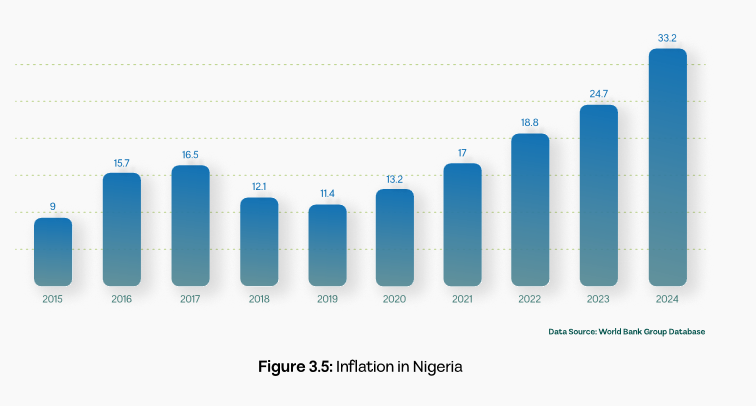
From 2015 to 2020 (pre-pandemic), Nigeria was able to keep inflation in check. From 2021 to 2024 (post-
pandemic) cost of living has been on a rapid rise, reducing the purchasing power of its citizens.
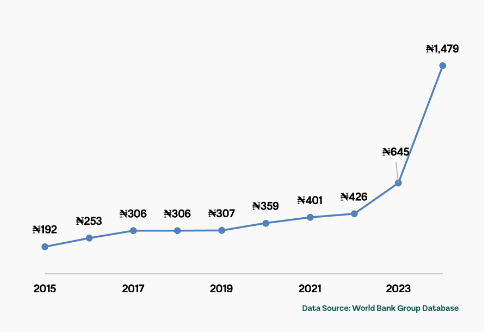
The exchange rate in Nigeria has depreciated by 770% against the US dollar from 2015 to 2024. This is a huge loss of value of the naira in the long-term view, and this is a huge red flag for investors seeking long-term investments in the country. This, coupled with inflation, will affect the level of capital inflow, assets, foreign direct investments, and even stop banks from giving out loans to individuals and businesses, especially when the increment in the exchange rate exceeds the interest rate on loans. They would rather buy dollars rather than give Naira to individuals, small and medium enterprises.
Inflation is moderating across several regions but remains above target in many economies. Food and energy price volatility remains a major driver. High inflation and exchange rate erode purchasing power, increase interest rates, and raise loan defaults. Lower inflation and exchange rates improve banking stability and investor confidence. North Africa is moderating as subsidies and monetary tightening stabilize price levels. East Africa gradual easing but remains vulnerable to climate and currency pressures. West Africa is mixed as Nigeria’s inflation remains high; some countries in the zone see better stability in inflation and exchange rate. Central Africa moderating as commodity revenues strengthen currencies. Southern Africa has sticky inflation, but within manageable bounds for South Africa and Botswana.
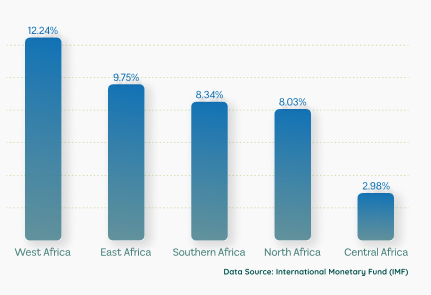
West Africa has the highest average inflation with 12.24% in 9 years, followed by East Africa 9.75%, Southern Africa 8.34%, Northern Africa 8.03%, and Central Africa 2.98%. For Banks, high inflation forces restrictive monetary policy, shrinking credit growth. For investors, inflation volatility pushes foreign investors to safer regions or USD-denominated assets. High inflation deters long-term investment and increases project financing costs.
Strategic actions to deepen capital formation
Resilience of Banking Sector in the continent signals profitability, adequate capital buffers, and moderated non-performing loans, suggesting that Africa’s banking sector is roughly stable. That stability provides a foundation for mobilizing domestic savings, extending credit to the private sector, and supporting enterprise growth. In effect, banks can serve as engines of capital allocation, which is crucial where external financing may be uncertain. Improved macroeconomic environment enhances investment appeal. The downward trend in inflation across much of Sub-Saharan Africa from double-digit peaks to median mid-single digits improves the macroeconomic environment. Lower inflation reduces uncertainty, improves real returns, and allows for lower real interest rates, which together enhance attractiveness to both domestic investors and foreign capital seekers. Regional divergence is a barrier to uniform capital growth; the wide variation across zones (in non-performing loans, return on equity, and banking health) highlights that Africa is not uniform. Capital accumulation, investment flows, and banking-led growth will likely concentrate in sub-
regions with stronger financial and macro fundamentals. Regions lagging on these metrics risk being left behind, exacerbating regional disparities in growth, investment, and development.
Importance of Local Credit, Domestic Banking, and Financial Deepening, given that global foreign direct investment flows are volatile and increasingly constrained by global rate cycles and geopolitical uncertainty, a healthy domestic banking sector becomes even more critical. Well-capitalized banks with low non-performing loans and stable returns can mobilize domestic capital, fund infrastructure, small and medium enterprises, and support broader economic development even if foreign capital is scarce. Policy sensitivity is needed for prudential regulation and macroeconomic Stability. The interplay between inflation, interest rates, bank profitability, and financial stability is delicate. As noted by AfDB, tight monetary policies to curb inflation may strengthen price stability but can also strain banks if credit growth slows or borrowers default. This reinforces the need for prudent regulation, risk management, and macroeconomic coordination.
Is capital deepening and flowing into productive sectors?
Overall, the recent data paint a cautiously optimistic picture: Africa’s banking sector appears resilient, shaped by profitability, adequate capital, improving asset quality, and a gradually stabilizing macroeconomic environment (inflation). This sets a foundation for improved domestic capital mobilization and lending, both critical for investment, business expansion, and long-term growth. So yes, capital is flowing into productive sectors like infrastructure investments, value chain investments, and renewable energy/power. However, progress will likely remain uneven across zones. Regions like West Africa, Southern Africa, and parts of East Africa seem best positioned to attract both domestic and foreign capital, while Central Africa and weaker economies may struggle unless they improve banking-sector soundness, governance, and macroeconomic stability. In a global environment of tightening financing conditions and shifting investor sentiment, the robust performance of domestic banks could become one of Africa’s most reliable levers for sustainable development, provided policymakers and regulators preserve financial stability, encourage credit growth prudently, and support economic diversification.