Employment trends and labour market challenges
Jobs, economy, and trade are key sectors in every country in the world; no country would be able to survive without them. In Africa, jobs and trade have been the backbone of the continent’s survival, as each country depends on the others for goods and services it specializes in. In 2020, the world economy was put on hold, people were told to go home and isolate themselves and their households to prevent the spread of Corona virus. The impact of these not only affected the working class and business people, but it also affected the entire economic activity as borders were shut down and rendered services, goods in transit that were supposed to ease the needs of the people were also held for safety concerns. People in idleness, alongside other factors, contributed to the violence outbreak in various countries across the continent, like the ENDSARS movement in Nigeria. The Covid-19 was glaring evidence to us (households, businesses, and the government) that the economy in various countries across Africa cannot survive without jobs and trade, as many are gainfully employed in the informal sector and living on daily incomes.
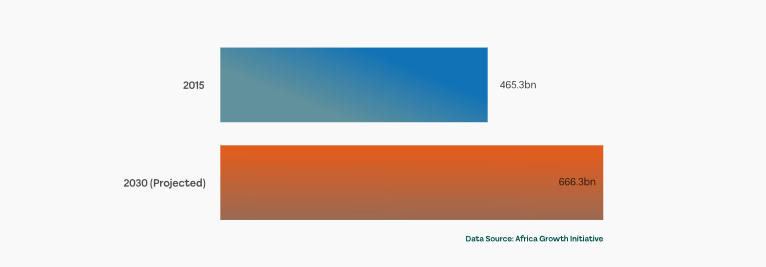
Africa’s manufacturing sector was stagnant five years ago, constrained by high energy costs and weak logistics. Today, import pressures, supply-chain re-shoring, and AfCFTA are reviving interest in regional manufacturing hubs. Food processing, pharmaceuticals, building materials, textiles, and light assembly are seeing increased investment. Manufacturing’s main value lies in job creation, with business-to-business spending projected to reach $666.3 billion by 2030, up $201 billion from 2015.
Youth employment and skills mismatch
According to the most recent edition of the World Bank’s Africa’s Pulse (October 2025), sub-Saharan Africa all (SSA) is projected to grow at 3.8% in 2025, rising to 4.4% annually in 2026–27 under baseline assumptions of all things being equal, the working-age population is set to expand by over 600 million people by 2050; “only about 24% of new workers today are engaged in wage-paying jobs.” This indicates that the job is and will be a challenge to various people across the continent as the workforce continues to outgrow the number of jobs available across sub-Saharan Africa. Most new jobs in SSA are low-productivity and in unstable industries, meaning many jobs do not translate into stable income growth or poverty reduction.
What this means: Economic growth alone does not translate into stable employment at scale; the structure of employment remains twisted toward casual, low-productivity jobs. Given the rapid demographic expansion of large young labour-force applicants and the inability to create sufficient quality jobs, unemployment, underemployment, poverty, and social stress. GDP growth might suggest structural transformation in the economy, but it does not necessarily mean job creation, as various factors like capital formation, low interest rate, exchange rate, inflation, and even external factors can drive GDP growth.
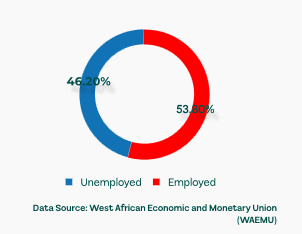
According to a 2025 report on labour markets in the region, the employment rate in the West African Economic and Monetary Union (WAEMU) rose to 53.8% in Q4 2024, from 51.3% in the previous quarter; unemployment reportedly fell to about 11.6%. Nevertheless, the region remains heavily informal. With limited “skilled labour” and a shortage of medium-sized firms capable of providing stable wage employment.
Economic diversification and industrialisation
According to the Africa Development Bank (AFDB), Africa’s overall economy is projected to grow by 3.9% in 2025, reaching around 4.0% in 2026. The pace of growth varies significantly by region: AfDB projects East Africa leading with about 5.9% growth in 2025–26; West Africa about 4.3%, North Africa around 3.6%, and Southern Africa much slower, 2.2% in 2025 (see Figure 6.3).
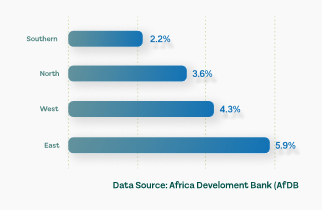
According to the Africa Development Bank (AFDB), Africa’s overall economy is projected to grow by 3.9% in 2025, reaching around 4.0% in 2026. The pace of growth varies significantly by region: AfDB projects East Africa leading with about 5.9% growth in 2025–26; West Africa about 4.3%, North Africa around 3.6%, and Southern Africa much slower, 2.2% in 2025 (see Figure 40).
This indicates that though growth continues, persistent structural issues (informality, low productivity, insufficient firm growth) undermine the capacity of growth to generate broad-based welfare improvements.
The diverse growth performance suggests a multi-speed Africa: some sub-regions (East, parts of West) may harness growth more effectively; others (Southern, North) might lag. Modest per-capita GDP growth indicates that aggregate growth does not automatically translate into substantial gains in living standards, especially if population growth remains high and employment remains informal. Growth concentrated in certain sectors (natural resources, extractives, commodity exports) may generate GDP growth without corresponding broad-based economic transformation or employment gains.
Intra-African trade and AfCFTA implementation
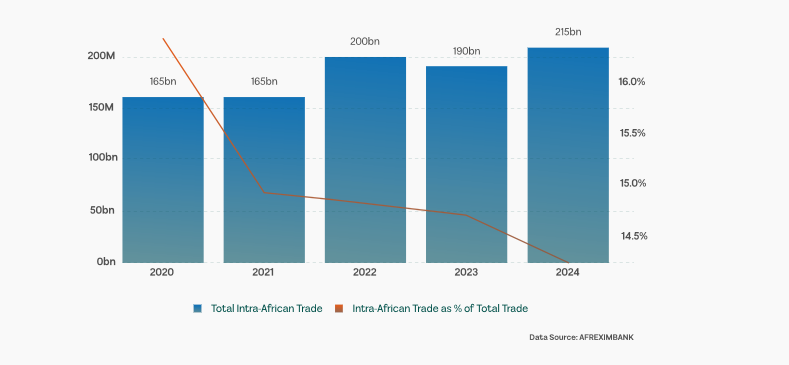
Intra-African investment remains modest but is growing steadily. Trade reached $190billion in 2023, with its share rising to 14.9%. Most regional investment is in services, while extractives still dominate external investment. South Africa, Kenya, and Nigeria lead regional flows. AfCFTA is reducing barriers and improving market access, though currency controls, regulatory differences, and high logistics costs still limit integration.
Global trade tensions, tariff uncertainty, and the global economic slowdown continue persist; many African economies remain resilient, with a subset of 21 countries still expected to grow by more than 5% in 2025. However, the AfDB notes that slower global demand and policy uncertainty could negatively affect trade — imports and exports, which may weigh on countries dependent on commodity exports or global supply chains. Intra-African foreign direct investment is concentrated in services, including finance, telecommunications, business services, and tourism. Extra-African investment continues to focus on extractive industries. South Africa, Kenya, and Nigeria are the largest sources of regional investment. Despite this growth, intra-African investment remains small, contributing roughly 5% of employment creation and less than 3% of total capital deployed. This research has proven that deeper economic integration, better institutional quality, infrastructure, and human-capital investments are strongly associated with increased intra-African trade and structural economic transformation. For many African countries, trade and structural diversification remain critical levers for sustainable growth and employment: moving beyond commodity/export-led growth toward value-added manufacturing, agro-processing, services, and trade integration (both intra-African and global). Overdependence on commodity exports (oil, minerals, raw agriculture) remains risky as global price swings, trade disruptions, and external demand shocks can quickly reverse growth gains. Only integration (through regional trade agreements, improved infrastructure, and institutional reform) can unlock economies of scale, link SMEs to regional value-chains, enhance foreign direct investment (FDI), and catalyse structural change.
Zone Trade and Structural Dynamics
The West and Central Africa region has the demographic base and natural-resource potential to benefit significantly from trade-led growth and structural transformation. If policy supports diversification, value-addition in agriculture and natural resources, and trade integration (intra-regional and global), there is a potential for structural transformation away from subsistence agriculture and informality. But fragility, political instability, weak infrastructure, and institutional weaknesses remain constraints. East Africa, with robust growth and improving macroeconomic stability, stands out as a candidate for expanding manufacturing, services, and regional export-oriented production. As regional trade integration (e.g., via regional economic communities) deepens and infrastructure improves, East Africa could become a hub for regional value chains, leveraging the demographic dividend and rising domestic demand. Southern Africa region’s heavy reliance on extractive/commodity sectors and exposure to global commodity price volatility make diversification urgent. Success depends on investing in manufacturing (e.g., value-added agriculture, agro-processing), infrastructure, and trade facilitation, but structural rigidities and economic headwinds pose challenges. North African economies often more industrialized and connected globally, have a comparative advantage in trade and structural transformation. With stable institutions, proximity to Europe and the Middle East, and relatively diversified economies, the region can leverage trade, manufacturing, tourism, and services to sustain growth and job creation.
Emerging Patterns: Growth without transformation across many zones, GDP growth persists, but structural transformation and quality job creation lag — a classic “jobs-poor growth” scenario. Informality remains pervasive with evidence indicating that a majority of jobs in SSA remain informal, low-productivity, and subsistence-based — limiting income growth, social protection, and firm development. Divergent regional trajectories in some zones (East Africa, parts of West Africa) show potential for structural transformation; others (Central/fragile states, resource-dependent economies) risk stagnation or decline. Need for medium & large firms, as highlighted by the World Bank, shifting growth models toward medium/large firms is key to generating wage employment at scale. Trade & diversification as critical levers for sustainable growth, countries must pivot away from raw-commodity exports and toward value-added industry, regional value chains, trade integration, and diversified economies.
Is growth generating enough quality jobs and trade opportunities?
From a vantage point of a decade observing African economies, the following scenario seems likely over the next 5–10 years if the right policies are implemented. Africa will continue to grow, but much of that growth will remain jobs-poor unless structural transformation accelerates. A few zones (notably East Africa and parts of West Africa) may successfully transition toward diversified, export-oriented, value-added economies with growing formal employment, stronger manufacturing or service sectors, and expanding middle-class incomes. Many countries/regions may remain stuck in a cycle of informality, low productivity, and vulnerability to commodity cycles or global shocks, especially those dependent on extractive industries or lacking institutional capacity. Trade and regional integration If advanced, will be a major driver of structural transformation, enabling economies of scale, cross-border value-chains, and more stable economic growth. The demographic dividend (youth bulge) will remain both an opportunity and a risk. With effective investment in human capital and economic diversification, it can drive growth; without it, it may exacerbate unemployment, poverty, and instability.
In short, Africa stands at a crossroads. Resilient growth continues, but turning growth into broad-based prosperity, jobs, and structural transformation will require bold policy, institutional reforms, investment, and strategic diversification.