Africa stands at an essential point in its energy and infrastructure evolution. Once defined by long-lasting electricity deficits and heavy reliance on traditional biomass, the continent is now undergoing a gradual transformation shaped by economic growth, demographic expansion, technology advances, and global decarbonization pressures. Energy is central to this shift, not only as a catalyst for industrialization and development but also as a foundation for sustainable growth. This analysis explores the state of power, infrastructure, and energy in African countries using key metrics like renewable energy investments, access rate, power generation and consumption trends, energy use per capita, liquefied petroleum gas (LPG) adoption, and infrastructure development index.
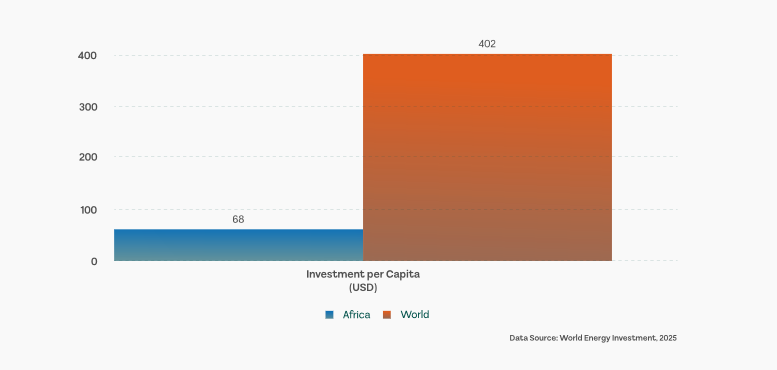
Africa’s renewable energy sector is growing rapidly. Investment rose from about $2.6 billion in 2021 to an estimated $40 billion in 2024, the fastest growth period on record. Despite this progress, Africa still receives less than 3% of global clean-energy investment, even though it accounts for nearly 20% of the world’s population and has vast renewable resources. To reach its target of 300 GW of renewable capacity by 2030, Africa needs around $100 billion per year. Current investment leaves an annual gap of about $60 billion, showing that recent gains, while historic, are not yet sufficient.
Technology Mix and Gaps
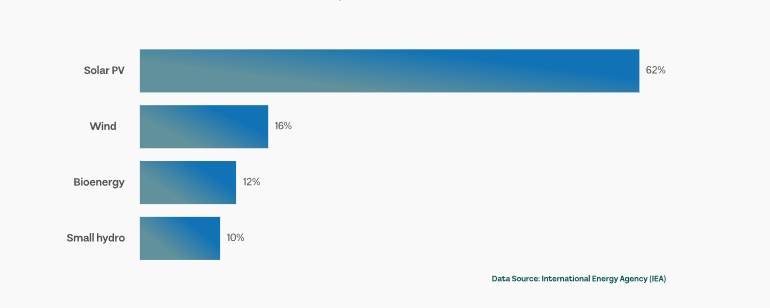
In 2024, renewable investment was heavily concentrated in solar power, which made up 62% of total investment. Wind accounted for 16%, while bioenergy and small hydropower made up the rest. Solar’s dominance reflects its low cost and fast deployment, but limited diversification weakens grid stability and underuses Africa’s wind, hydro, and geothermal potential.
Private Capital and Financing Models
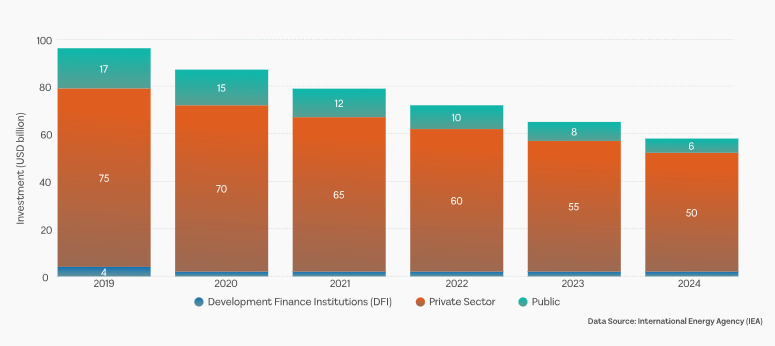
Private investors are playing a growing role. By 2025, private renewable investment is expected to reach $900 million, mainly in pay-as-you-go solar, mini-grids, and embedded generation. These projects are smaller than utility-scale plants but are critical for expanding access in underserved areas. Overall, the private sector provides about 75% of total energy investment, supported by risk-sharing and blended-finance tools from development finance institutions, which help reduce risk and attract capital.
Access rate and energy availability represent the percentage of the population with access to electricity. A high access rate indicates widespread electricity coverage, critical for economic development and quality of life. As of the early 2020s, almost 43% of the population in African have access to electricity.
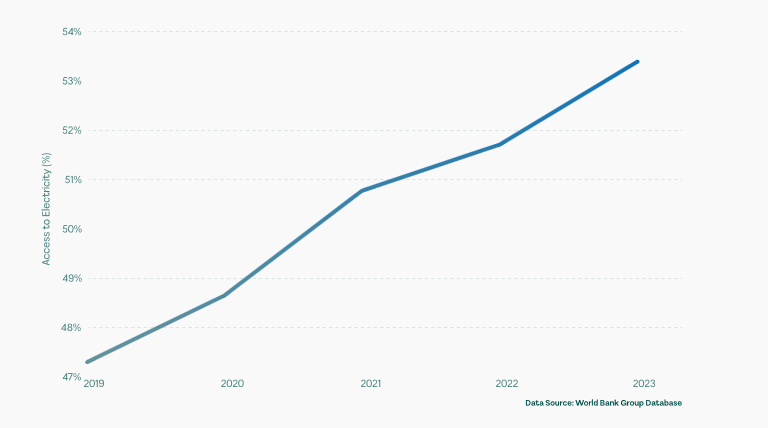
However, the access rate has improved significantly over the past decade, especially in North African countries like Egypt, Morocco, and Algeria, achieving 100% of both urban and rural areas from the previous range of 90% in 2015.
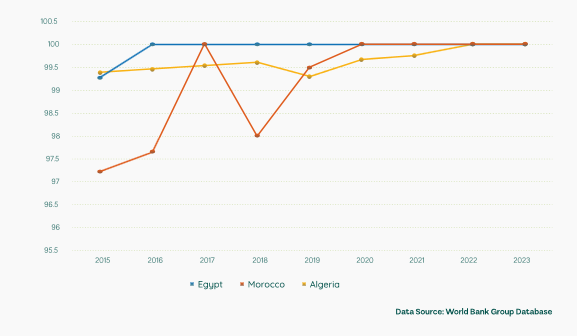
Looking at the chart above, North African countries like Egypt, Morocco, and Algeria have all had an upward trend in the electricity broadband coverage, including both urban and rural areas of their respective country. While certain region has been outstanding, there are other regions still struggling to give their citizens the desired level of access to electricity in both rural and urban areas, like West African countries.
Access rate and energy availability represent the percentage of the population with access to electricity. A high access rate indicates widespread electricity coverage, critical for economic development and quality of life. As of the early 2020s, almost 43% of the population in African have access to electricity.
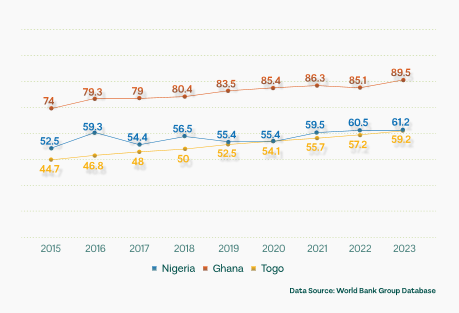
These three countries have improved their electricity access rate from what it was in 2015 to 2023, but you can see they were not even close to the North African countries, and that is due to the infrastructure gap in power generation, distribution, and transmission.
Africa’s total power generation capacity exceeded 256 gigawatts in 2023, according to the International Renewable Energy Agency (IRENA), less than 3% of the world’s total output. With countries like South Africa, Nigeria, Egypt, and Algeria accounting for the majority majority of the total generation on the continent, creating a highly uneven energy landscape.
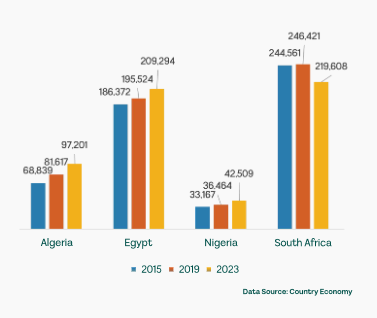
Algeria has increased its power generation by 41% from 2015 to 2023, Nigeria 28%, Egypt 12%, and South Africa has seen a -10% decline during the same time frame, respectively. While South Africa has experience decline in its output level despite being ahead of the rest. These countries have different sources of electricity generation. Algeria (natural gas), Nigeria (natural gas and hydropower), Egypt (natural gas), and South Africa (coal). Renewable energy is growing rapidly, especially solar energy, hydropower, and geothermal, which signals a gradual but meaningful transition towards clean energy systems.
Power consumption, on the other hand, has been below the level of generation in these countries because the 4 countries don’t just see power as a source to light up their economy but also as a source of income by exporting the excess to neighbouring countries around them.
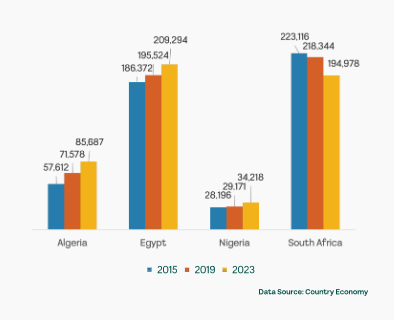
Algeria has seen a 49% increment in power consumption (compared to it 41% generation increment) from 2015 to 2023, Egypt 4% increment (compared to 12% generation increment), Nigeria 22% increment (compared to 28% generation increment) and South Africa -12% decline (compared to 10% generation decline) during the same time frame. Only Algeria is consuming more power than it can produce, and it’s just a matter of time before it encounters a deficit if its generation capacity is not massively improved. The per capita electricity consumption in Africa remains extremely low (550 KWh) per person annually, compared to the global average of over 3,000 KWh. This indicates vast room for growth.
Despite improvements, Africa’s energy use per capita remains the lowest in the world, averaging 0.6 toe (tonnes of oil equivalent) per person, compared to the global average of 1.9 toe. Industrial and transport sectors absorb the largest share, while household depends on biomass (a major source of indoor air pollution and environmental degradation) in Africa.
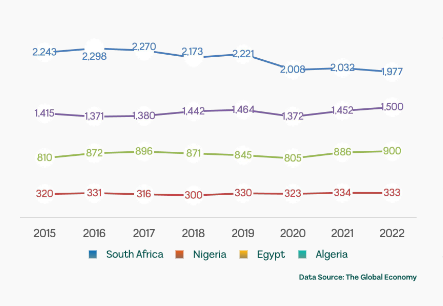
The level of energy per capita in South Africa is much higher than in other countries, but has seen a decline in use per capita from 2015 to 2022. Nigeria, Algeria, and Egypt have an increase in energy use per capita from 2015 to 2022. Growing urbanization and the expansion of middle-class consumers are increasing energy demand, creating both challenges and opportunities for efficiency and clean technology adoption. Energy efficiency policies are gaining traction through regional programs led by the African Union and development partners.
Liquefied petroleum gas adoption is a critical component of Africa’s clean cooking transition. Traditional biomass (wood, charcoal, crop waste) still supplies about 45% of total primary energy, affecting health and forests. Liquefied petroleum gas use has grown steadily, especially in Nigeria, Ghana, Kenya, and Senegal, supported by subsidies reforms and distribution network investments.
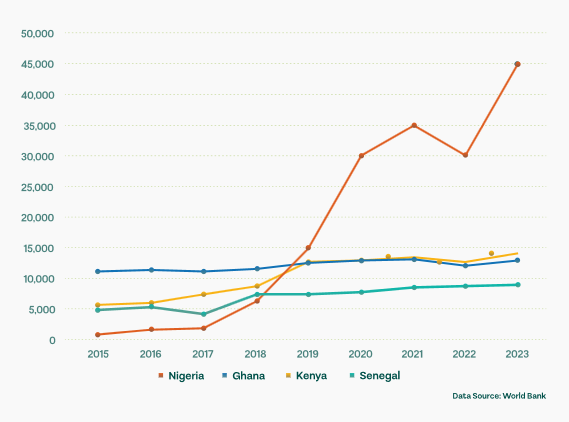
We can see from the chart above that the use of LPG over time from these countries has grown, especially in Nigeria, almost X50 from 2015 to 2023 (962 to 44,802). The average LPG consumption per capita in these countries is 4kg per year, while the global average is 15kg.
Infrastructure financing
The infrastructure development index measures the quality and availability of transport, energy, ICT, and water infrastructure. It shows that energy infrastructure remains a bottleneck for most African countries.
According to the Africa Development Bank (AFDB), Africa needs to invest $130-$170 billion annually in infrastructure, with an energy sector financing gap of over $40 billion per year.
The data below captures the infrastructure index in various countries, categorizing them by region.
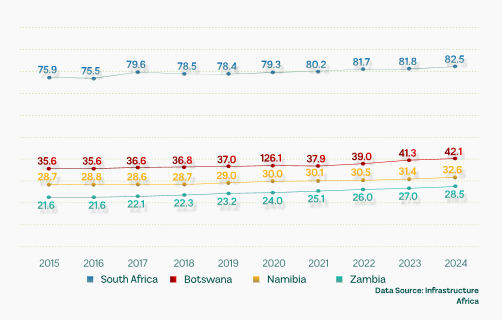
South Africa leads the index, showing the level of investment put in place by the government to ease the lives of citizens and enhance overall development across each sector. Botswana, Namibia, and Zambia are also improving from where they were in 2015, but they are below average, which means the governments in each country have to dedicate a larger percentage of their GDP to improve their infrastructure.
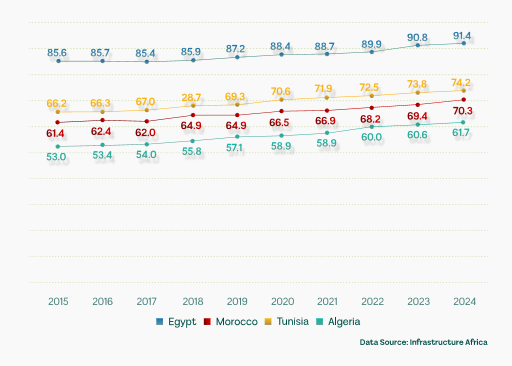
Egypt is always setting an example for other African countries in North Africa when it comes to power, infrastructure, and energy. North African countries are relatively better than the Southern African countries used in this report. Algeria been above average shows the level of commitment in the region to improve infrastructure.
Enabling infrastructure for growth and competitiveness
The direction of change across Africa’s energy landscape is clear. Decentralization, mini-grids, and solar home systems are extending access faster than traditional grid expansion. Diversification, the energy mix is becoming more varied, reducing dependence on coal and oil across the continent. Digitalization using smart meters, mobile payments, and data-driven systems is transforming energy management. Regional integration by power pooling and infrastructure guides is linking markets and improving efficiency. Sustainability by ensuring climate commitments and green finance are steering investments towards renewables and energy efficiency.
Strengthening Energy Data Systems and Statistics: The African Energy Commission (AFREC) has for years developed the African Energy Information System (AEIS), a continental-level data platform and decision-support tool. A large database system that collates data on energy balances, hydropower, biomass, and more. These systems have helped improve governance, capacity, and quality of the national energy information system. It also runs trainings for national energy stakeholders in various countries, such as South Africa. Better data infrastructure means more accuracy in energy systems. There have also been collaborations, IEA and AFREC. IEA (International Energy Agency) is working with AFREC to help countries assess data gaps.
National Energy Compacts (Mission 300): 12 countries presented National Energy Compacts at the 2025 Mission 300 Africa Energy Summit. These compacts are national level policies where governments set concrete targets and policy measures for:
- Expanding energy infrastructure
- Regional power integration
- Distributed renewable and clean cooking
- Private sector participation, and
- Strengthening utilities
Just Energy Transition Partnerships (JETPs): Several African countries, like South Africa and Senegal, have signed to become development partners on energy. The South African government under JETP has negotiated policy-based financing to support a shift away from coal, with social protections, job transition, data integration, and infrastructure modernization. Senegal JETP reforms support renewable deployment and universal access. With the targets of raising the renewable share to 40% by 2030. JETPs in various countries generally come with monitoring, reporting, and verification frameworks. To meet their commitments by producing reliable data on emissions, generation mix, capacity deployment, and social outcomes to enable transparency for international financiers.
Kenya/Regional Integration: Kenya’s policy moves in East Africa; it recently conducted a trial to transmit electricity from Ethiopia to Tanzania, signaling deeper regional integration. The cross-border trading requires low costs and reliability, meaning infrastructure policy is pushing towards a more data-intensive system that requires capital and financing. Showing it is both a policy and a capital project, as both are two sides of a coin (power and energy).