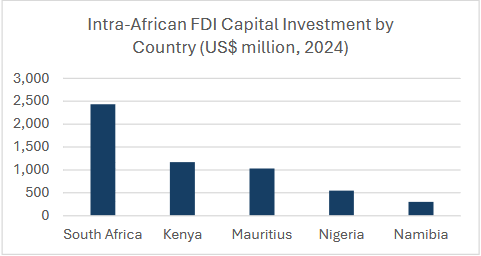
The strongest form of intra-African investment is corporate, not institutional. Dangote Group remains one of the clearest examples. Dangote Cement operates across multiple African markets including Ethiopia, Senegal, and South Africa, while the Dangote Refinery is expected to reshape regional fuel trade dynamics across West and Central Africa. The company’s recent $1 billion investment commitment in Zimbabwe reflects continued confidence in long- term regional demand.
South Africa’s MTN has built one of the continent’s largest telecommunications networks across 18 African countries, while Ecobank maintains operations in 36 countries, making it one of Africa’s most geographically diversified financial institutions.
Banking is the fastest-growing channel of intra-African investment, driven by high returns in underbanked markets such as the DRC. This has attracted major expansion by Standard Bank, Access Bank, UBA, and Equity Group. The implication is that intra-African investment is likely to be more durable because it is driven by commercial returns, not development policy. However, this also means investment will remain uneven, concentrated in high-return markets and sectors rather than being evenly distributed for development outcomes.
Morocco leads the most coordinated regional expansion strategy. Institutions such as Attijariwafa Bank, Banque Centrale Populaire, and Maroc Telecom are systematically expanding across West and Central Africa, reflecting a state-aligned push into regional markets. These firms are among the continent’s most active cross-border investors, signalling integration that is advancing faster than formal frameworks like AfCFTA.