The proposed Dangote East Africa Refinery would process crude from Uganda, the DRC, South Sudan, and Kenya at a target throughput of 650,000 barrels per day — matching the nameplate capacity of the Lagos facility and making it, at full operation, the largest refinery in sub-Saharan Africa. Refined output would be distributed across Tanzania, Kenya, Uganda, Rwanda, and the DRC, with surplus volumes available for export via Indian Ocean shipping routes to Asian and Middle Eastern markets.
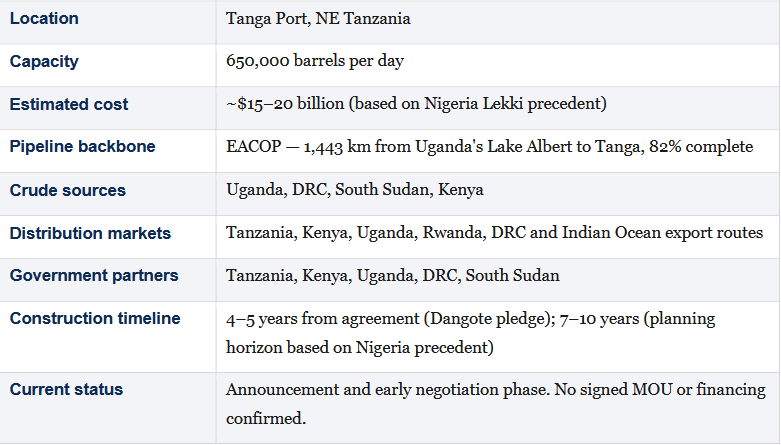
Tanga Port is not an arbitrary choice of location. Three factors make it the only commercially viable site for a refinery of this scale in East Africa. It is the Indian Ocean terminus of the East African Crude Oil Pipeline — the 1,443-kilometre heated pipeline running from Uganda’s Tilenga and Kingfisher oil fields — which provides the only infrastructure capable of moving landlocked East African crude to the coast at commercial volumes. Its deep-water berths are certified for Very Large Crude Carriers, enabling direct access to export markets without transshipment. And the port sits within Tanzania’s Special Economic Zone framework, which provides the tax and regulatory incentives required for a project of this capital intensity to pencil commercially. No other port in the region combines all three.
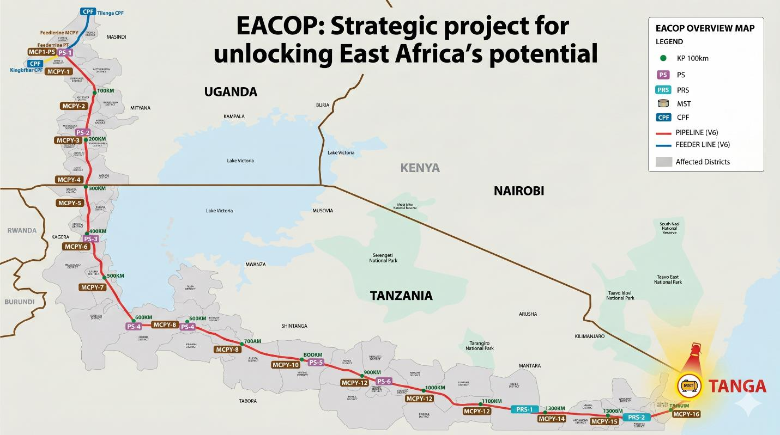
The operational linkage between EACOP and the refinery is non-negotiable. At 82 percent complete as of early 2026, EACOP is the primary crude supply route. Without its completion, the refinery has no feedstock. The two projects are inseparable in both timing and commercial logic.