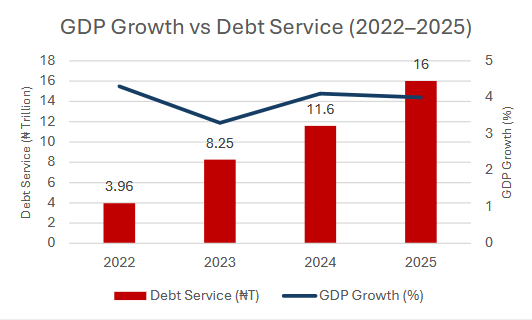
Nigeria in 2026 is shaped by two realities moving in opposite directions.
On the one hand, the growth outlook remains positive. The IMF projects GDP to reach $334 billion in 2026, which could place Nigeria as Africa’s third-largest economy, behind South Africa and Egypt and ahead of Algeria. This is supported by rising oil production, improved foreign exchange liquidity, and gradual gains from earlier economic reforms.
On the other hand, fiscal conditions remain under pressure. Debt service is projected to absorb about 50% of federal revenue in 2026. At the same time, the fiscal deficit is expected to widen to ₦23.85 trillion, or 4.28% of GDP, above the 3% limit set under the Fiscal Responsibility Act.
The key risk is not sovereign default. Nigeria retains sufficient capacity to meet its debt obligations. The concern is instead a drag on growth, as an increasing share of public revenue is diverted toward interest payments rather than productive investment in infrastructure, power, and education. Over time, this limits the economy’s ability to fully translate growth into broad-based development, as debt servicing crowds out capital expenditure.
This pressure is being reinforced by continued borrowing. The House of Representatives has approved a $6 billion external borrowing request, expanding access to additional financing from lenders in the UAE and the UK. This further adds to a debt stock that has already more than tripled in the past three years.
As Figure 1 shows, this trajectory is visible across every quarter since 2023 — with naira-denominated debt rising steeply while the dollar series tells a more nuanced story shaped largely by exchange rate adjustment rather than net new borrowing alone.